ECO-FRIENDLY RESTAURANT BUSINESS PLAN
I. Executive Summary
Company Description
The company name is not provided. Operating in the U.S. restaurant industry, this contemporary, chef-driven concept launches in 2026 and offers a seasonal tasting menu plus a high-end mocktail program. Core services include in-house dining, curated tasting experiences, limited takeout of seasonal items, and reservations-driven private events. Kitchen operations center on zero-waste practices and suppliers vetted for low environmental impact; facility management uses energy-efficient systems to minimize footprint. One clear point: premium dining and rigorous sustainability coexist here.
We target a sophisticated, quality- and transparency-focused market segment that values community connection and sustainable choices. Short-term goals are to open in 2026, build local reputation, and stabilize operations; long-term goals are to prove the unit economics of sustainable fine dining and to replicate the model selectively. What sets us apart is the combination of a chef-led seasonal program, full sustainability commitment, and a premium non-alcohol beverage line. One clear point: profitable sustainability drives our strategy.
Problem
Metropolitan diners in markets like Austin, Texas want premium, chef-driven dining with transparent farm-to-fork sourcing and measurable environmental performance, but current upscale options lack verifiable sustainability and generate excess food waste and energy consumption. This leaves the 25–55 demographic choosing between ambiance, higher prices, or skipping premium dining for ethical reasons.
There is a clear market gap: no widely available premium restaurant that pairs luxury dining with documented, low-impact operations—creating unmet demand for guilt-free upscale meals.
Solution
Modern diners aged 25–55 want premium dining that aligns with environmental and ethical values; this concept closes that gap by offering a chef-driven, seasonal tasting menu paired with a zero-waste kitchen, on-site or hauled composting, energy- and water-saving fixtures, and direct sourcing from local farms and fisheries to provide traceability and reduced resource use.
One line: a high-end, sustainable dining destination delivering refined seasonal cuisine with demonstrable waste and resource reductions.
Mission Statement
We create exceptional dining that proves fine food and total environmental responsibility belong together. Through direct partnerships with local growers and a zero-waste operational philosophy, we deliver transparent, guilt-free, flavorful meals that reflect guests’ values. We innovate in kitchen and bar operations to lead hospitality toward a more sustainable, ethical future.
Key Success Factors
These factors together drive revenue, margin, and rapid payback for the eco-friendly restaurant.
-
40% mocktail sales mix captures high-growth non-alcoholic demand and boosts check averages.
-
Direct sourcing secures superior ingredients and supports a food COGS of 7.0% or less.
-
$150,000 high-end build-out plus strategic location enables a $60.00 weekend average check.
-
Experienced ops team led by a General Manager at $70,000/year ensures execution and cost control.
-
Breakeven in 14 months delivers early fiscal stability and funds scalable growth.
Financial Summary
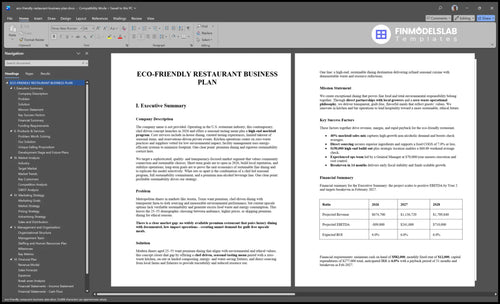
Financial summary for the Executive Summary: the project scales to positive EBITDA by Year 2 and targets breakeven in February 2027.
Ratio |
2026 |
2027 |
2028 |
Projected Revenue |
$674,700 |
$1,136,720 |
$1,789,840 |
Projected EBITDA |
-$99,000 |
$241,000 |
$710,000 |
Expected ROI |
6.0% |
6.0% |
6.0% |
Financial requirements: minimum cash on hand of $582,000, monthly fixed rent of $12,000, capital expenditures of $277,000 total; anticipated IRR is 6.0% with a payback period of 31 months and breakeven in Feb-2027.
Outlook: the plan reaches breakeven early 2027 and grows to a Year 5 EBITDA of $2,163,000.
Funding Requirements
We need $859,000 in total to launch and sustain the restaurant through the minimum cash month: $277,000 in capital expenditures, $10,000 in initial inventory, and $582,000 in working capital to cover the cash trough (breakeven expected February 2027; payback 31 months; IRR 0.06; ROE 4.42).
Categories |
Amount, USD |
Capital expenditures (build-out, equipment, furniture, signage) |
277,000 |
Initial inventory stock |
10,000 |
Pre-opening and securing location (included in working capital) |
— |
Staffing (7.0 FTE initial hires; payroll reserve included in working capital) |
— |
Operating reserves to cover cash trough (Minimum cash - Jan 2027) |
582,000 |
|
|
Working capital |
582,000 |
Total funding required |
859,000 |