

Acquire Customers
Divide each channel's marketing spend by its CAC, then combine online and offline new customers.


It is an editable five-year workbook that models customer acquisition, repeat orders, product mix, pricing, and linked financial statements and dashboards.
Plan how marketing-driven customer acquisition, repeat purchasing, product mix, and pricing flow into sales, costs, cash needs, and financial performance over five years.
Change launch timing, marketing budgets, CAC, retention, ordering behavior, sales mix, and prices; the workbook carries those assumptions through monthly calculations and reports.
Revenue starts with channel marketing spend and CAC, adds repeat-customer cohorts, converts orders to units, allocates product mix, and applies category prices.
Divide each channel's marketing spend by its CAC, then combine online and offline new customers.
Convert a percentage of new customers into repeat cohorts active for their stated lifetime.
Add first-purchase orders to active repeat customers multiplied by repeat orders per month.
Multiply orders by units per order, then allocate units across product categories by sales mix.
Multiply each category's allocated units by its matching price and sum category revenue each month.
The Revenue sheet connects marketing spend, CAC, repeat behavior, order frequency, units per order, category mix, and yearly product prices.
 REVENUE
The COGS & OPEX sheet separates cost-of-goods assumptions from variable and fixed operating expenses across the forecast.
 COGS & OPEX
The Scenarios view compares Low, Base, and High cases for revenue, margins, and EBITDA over the five-year forecast.
 SCENARIOS
The Dashboard brings together scenario controls, financing and working-capital assumptions, core financials, revenue mix, cash flow, profitability, and payback charts.
 DASHBOARD
It fits stores using this customer-acquisition, repeat-order, product-mix revenue logic; structurally different revenue models or reporting needs may require custom work.
The template is a planning starting point, not a guarantee of performance.
Financial Models Lab can build or adapt a model when your revenue logic, operating schedules, or reporting requirements differ from this template.
ORDER A CUSTOM FINANCIAL MODELAfter checkout, you receive the editable Etsy and eBay Store financial model for immediate download and customization.
Use the pre-built Excel workbook and replace assumptions with your own store inputs.
Review a five-year forecast with monthly and annual cash-flow detail.
Compare Low, Base, and High cases across revenue, margins, and EBITDA.
Review projected profit and loss, cash flow, balance sheet, and summary outputs.
The essential answers are visible in full, with no accordion clicks required.
It divides channel marketing spend by CAC to acquire customers, adds repeat-order cohorts, converts orders to units, allocates product mix, and applies category prices.
You can change launch timing, channel marketing budgets and seasonality, CAC, repeat-customer behavior, units per order, sales mix, and yearly category prices.
You can compare alternative revenue, gross margin, contribution margin, and EBITDA paths across the five-year forecast.
The workbook includes projected profit and loss, cash flow, balance sheet, summary reporting, dashboard views, and related financial analysis.
Yes. Financial Models Lab can build or adapt revenue logic, operating schedules, and reporting when your required structure differs from the ready-made model.
It is a planning forecast based on editable assumptions, not a guarantee of business performance or financial results.
Your purchase includes a comprehensive, easy-to-use spreadsheet for tracking Etsy expenses and income, complete with financial statements, a visual dashboard, and detailed assumption tabs.
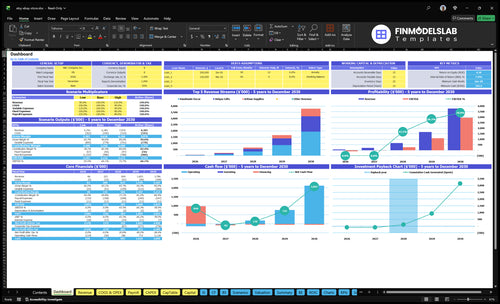
Core inputs and core outputs
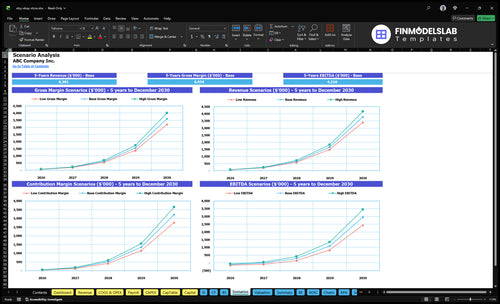
Three scenario analysis
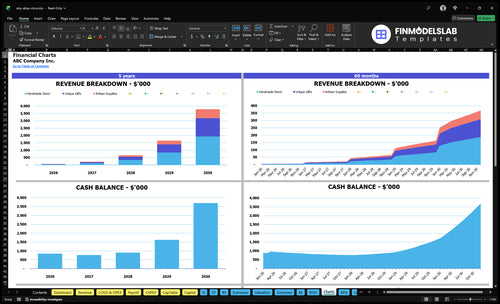
Presentation ready
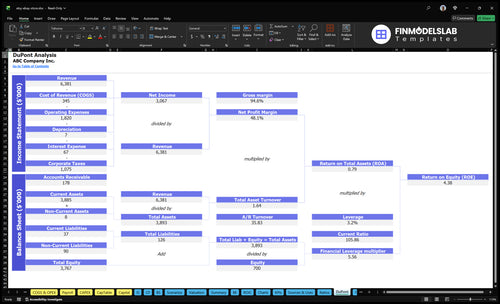
DuPont analysis
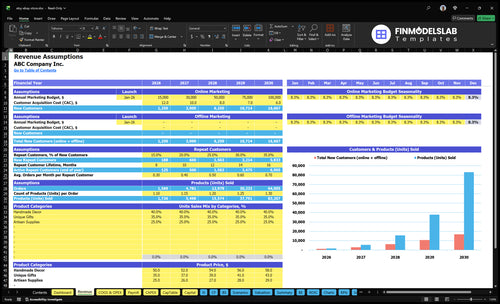
Researched revenue assumptions
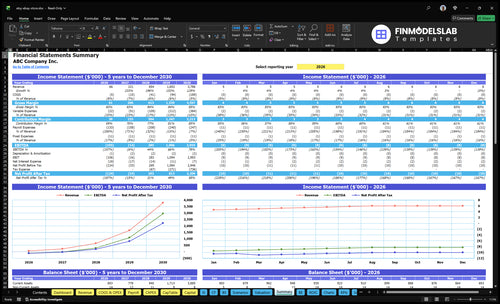
Lender-friendly financial outputs
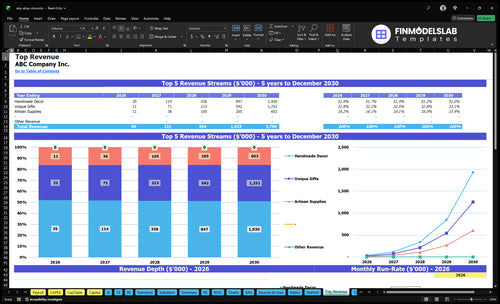
Revenue stream detailed view
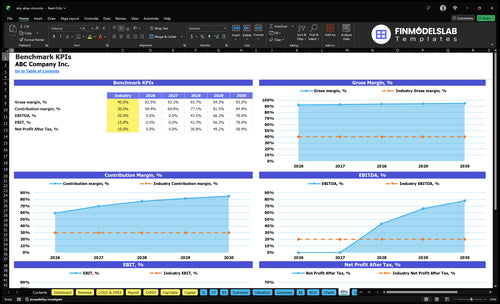
Performance metrics benchmark

This template made our cash needs easier to see, and I could spot a shortfall before it became a problem. It saved me a messy week of guessing and gave me a cleaner plan for the next 12 months.
I was able to build the Etsy and eBay projections in one afternoon instead of spending days in spreadsheets. That alone saved me about 10 hours and let me move on to pricing and listings.
I like that the tabs are already structured, because one bad formula used to throw off everything for me. With this model, I could make changes without worrying that the whole sheet would collapse.