FAIR TRADE STORE BUSINESS PLAN
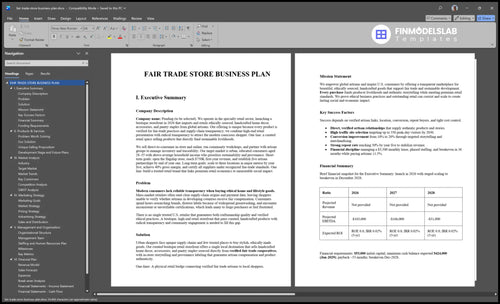
I. Executive Summary
Company Description
Company name: Pending (to be selected). We operate in the specialty retail sector, launching a boutique storefront in 2026 that imports and retails ethically sourced, handcrafted home decor, accessories, and pantry staples from global artisans. Our offering is unique because every product is verified for fair-trade practices and supply-chain transparency; we combine high-end retail presentation with radical transparency to attract the modern conscious shopper. One line: a curated retail space selling products that directly fund sustainable livelihoods.
We sell direct-to-consumer in-store and online, run community workshops, and partner with artisan groups to manage inventory and traceability. Our target market is urban, educated consumers aged 28–55 with above-average household income who prioritize sustainability and provenance. Short-term goals: open the flagship store, reach $750K first-year revenue, and establish five artisan partnerships by end of year one. Long-term goals: scale to three locations in major metros by year five, achieve 40% gross margin, and certify all suppliers under recognized fair-trade standards. One line: build a trusted retail brand that links premium retail economics to measurable social impact.
Problem
Modern consumers lack reliable transparency when buying ethical home and lifestyle goods. Mass-market retailers often omit clear supply-chain origins and payment data, leaving shoppers unable to verify whether artisans in developing countries receive fair compensation. Consumers spend hours researching brands, distrust labels because of widespread greenwashing, and encounter inconsistent or unverifiable certifications, which leads many to forgo purchases or feel frustrated.
There is no single trusted U.S. retailer that guarantees both craftsmanship quality and verified ethical practices. A boutique, high-end retail storefront that pairs curated, handcrafted products with radical transparency and community engagement is needed to fill this gap.
Solution
Urban shoppers face opaque supply chains and few trusted places to buy stylish, ethically made goods. Our curated boutique retail storefront offers a single local destination that sells handcrafted home decor, accessories, and pantry staples sourced directly from verified fair trade cooperatives, with in-store storytelling and provenance labeling that guarantee artisan compensation and product authenticity.
One-liner: A physical retail bridge connecting verified fair trade artisans to local shoppers.
Mission Statement
We empower global artisans and inspire U.S. consumers by offering a transparent marketplace for beautiful, ethically sourced, handcrafted goods that support fair trade and sustainable development. Every purchase funds producer livelihoods and authentic storytelling while meeting premium retail standards. We prove ethical business practices and outstanding retail can coexist and scale to create lasting social and economic impact.
Key Success Factors
Success depends on verified artisan links, location, conversion, repeat buyers, and tight cost control.
-
Direct, verified artisan relationships that supply authentic products and stories.
-
High-traffic site selection targeting up to 350 peak-day visitors by 2030.
-
Conversion improvement from 10% to 20% through targeted storytelling and merchandising.
-
Strong repeat rate reaching 50% by year five to stabilize revenue.
-
Financial discipline managing a $3,500 monthly lease, phased staffing, and breakeven in 36 months while paying artisans 11.5%.
Financial Summary
Brief financial snapshot for the Executive Summary: launch in 2026 with staged scaling to breakeven in December 2028.
Ratio |
2026 |
2027 |
2028 |
Projected Revenue |
Not provided |
Not provided |
Not provided |
Projected EBITDA |
-$163,000 |
-$166,000 |
-$31,000 |
Expected ROI |
ROE 0.8; IRR 0.02% (5‑yr) |
ROE 0.8; IRR 0.02% (5‑yr) |
ROE 0.8; IRR 0.02% (5‑yr) |
Financial requirements: $53,000 initial capital; minimum cash balance expected $424,000 (Jan‑2029); payback ~53 months; breakeven Dec‑2028.
Outlook: the business moves from early negative EBITDA to a projected $1,028,000 EBITDA in Year 5, supporting long‑term stability.
Funding Requirements
We need $53,000 in initial capex and a total raise of $450,000–$500,000 to launch in 2026 and reach breakeven in December 2028.
Categories |
Amount, USD |
Store build-out & renovation (capex) |
$53,000 |
Initial inventory procurement |
$0 |
First 36 months salaries & rent (operating shortfall) |
$360,000 |
Marketing & launch activities |
$0 |
Systems, POS & e‑commerce development |
$0 |
Contingency / cash buffer (to reach total range) |
$37,000–$87,000 |
Working capital |
$37,000–$87,000 |
Total funding required |
$450,000–$500,000 |