HANDMADE JEWELRY BUSINESS PLAN
I. Executive Summary
Company Description
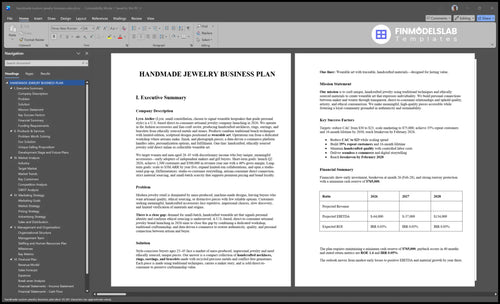
Lyra Atelier (Lyra: small constellation, chosen to signal wearable keepsakes that guide personal style) is a U.S.-based direct-to-consumer artisanal jewelry company launching in 2026. We operate in the fashion accessories and fine-craft sector, producing handcrafted necklaces, rings, earrings, and bracelets from ethically sourced metals and stones. Products combine traditional bench techniques with limited-edition, sculptural designs positioned as wearable art. Operations run from a dedicated workshop where artisans make, finish, and photograph pieces; a data-driven e-commerce platform handles sales, personalization options, and fulfillment. One-line: handcrafted, ethically sourced jewelry sold direct online as collectible wearable art.
We target women and men aged 28–45 with discretionary income who buy unique, meaningful accessories—early adopters of independent makers and gift buyers. Short-term goals: launch Q2 2026, achieve 1,500 customers and $500,000 in revenue year one with a 40% gross margin. Long-term goals: scale to $3M ARR by year five, expand limited-run collaborations, and open a studio-retail pop-up. Differentiators: studio-to-customer storytelling, artisan-consumer direct connection, strict material sourcing, and small-batch scarcity that supports premium pricing and brand loyalty.
Problem
Modern jewelry retail is dominated by mass-produced, machine-made designs, leaving buyers who want artisanal quality, ethical sourcing, or distinctive pieces with few reliable options. Customers seeking meaningful, handcrafted accessories face repetitive, impersonal choices, slow discovery, and limited verification of materials and origins.
There is a clear gap: demand for small-batch, handcrafted wearable art that signals personal identity and confirms ethical sourcing is underserved. A U.S.-based, direct-to-consumer artisanal jewelry brand launching in 2026 aims to close this gap by combining a dedicated workshop, traditional craftsmanship, and data-driven e-commerce to restore authenticity, quality, and personal connection between artisan and buyer.
Solution
Style-conscious buyers ages 25–45 face a market of mass-produced, impersonal jewelry and need ethically sourced, unique pieces. Our answer is a compact collection of handcrafted necklaces, rings, earrings, and bracelets made with recycled precious metals and conflict-free gemstones. Each piece is made using traditional techniques, carries a maker story, and is sold direct-to-consumer to preserve craftsmanship value.
One-liner: Wearable art with traceable, handcrafted materials—designed for lasting value.
Mission Statement
Our mission is to craft unique, handcrafted jewelry using traditional techniques and ethically sourced materials to create wearable art that expresses individuality. We build personal connections between maker and wearer through transparent, direct-to-consumer relationships and uphold quality, artistry, and ethical consumerism. We make meaningful, high-quality pieces accessible while fostering a loyal community grounded in authenticity and sustainability.
Key Success Factors
Targets: reduce CAC from $30 to $23; scale marketing to $75,000; achieve 35% repeat customers and 16-month lifetime by 2030; reach breakeven by February 2028.
-
Reduce CAC to $23 while scaling spend
-
Build 35% repeat customers and 16-month lifetime
-
Maintain handcrafted quality with controlled labor costs
-
Deliver seamless e-commerce and digital storytelling
-
Reach breakeven by February 2028
Financial Summary
Financials show early investment, breakeven at month 26 (Feb-28), and strong runway protection with a minimum cash reserve of $765,000.
Ratio |
2026 |
2027 |
2028 |
Projected Revenue |
|
|
|
Projected EBITDA |
$-64,000 |
$-37,000 |
$134,000 |
Expected ROI |
IRR 0.05% |
IRR 0.05% |
IRR 0.05% |
The plan requires maintaining a minimum cash reserve of $765,000; payback occurs in 40 months and stated return metrics are ROE 1.4 and IRR 0.05%.
The outlook moves from modest early losses to positive EBITDA and material growth by year three.
Funding Requirements
We seek $1,275,667 to cover a $32,000 initial CapEx package, $215,000 marketing plan (2026–2030), $78,667 cumulative operating losses to breakeven (month 26), $185,000 staffing reserve, and a $765,000 minimum cash reserve; projected EBITDA is -$64,000 in 2026, -$37,000 in 2027, rising to $988,000 by 2030, with a 40‑month payback, ROE 1.4, and IRR 0.05%, and units per order reaching 1.30 by year five.
Categories |
Amount, USD |
Product Development (initial CapEx: workshop, tools, site, inventory) |
$32,000 |
Marketing (5-year budget 2026–2030: $10k + $25k + $45k + $60k + $75k) |
$215,000 |
Operations (cumulative operating losses to breakeven — 26 months) |
$78,667 |
Staffing reserve (eventual annual payroll) |
$185,000 |
Other working capital needs |
$0 |
Working capital |
$765,000 |
Total funding required |
$1,275,667 |