

Acquire Customers
New customers equal channel marketing spend divided by matching CAC, adjusted by channel seasonality.


This editable five-year workbook forecasts a health and wellness e-commerce store from customer acquisition, repeat orders, product mix, costs, and linked financial outputs.
Plan how marketing spend, customer retention, order activity, product mix, pricing, and operating costs flow into a five-year e-commerce forecast.
Editable assumptions feed the monthly model, which rolls results into annual projections, financial statements, scenario analysis, and management reporting.
The model converts channel marketing spend into customers, repeat cohorts, orders, units, product-category allocation, and category revenue across the forecast.
New customers equal channel marketing spend divided by matching CAC, adjusted by channel seasonality.
A percentage of new customers becomes repeat buyers for the stated active lifetime.
Monthly orders combine first purchases with active repeat customers times repeat orders per month.
Orders convert to units, then the shared unit pool is allocated by product sales mix.
Allocated category units are multiplied by category prices and combined into total e-commerce revenue.
The Revenue worksheet links acquisition budgets, CAC, repeat-customer behavior, order volume, product mix, and category pricing to the sales forecast.
 REVENUE
The COGS & OPEX sheet separates direct product costs, variable selling expenses, and fixed overhead into editable monthly operating assumptions.
 COGS & OPEX
The Scenarios view compares Low, Base, and High cases for revenue, gross margin, contribution margin, and EBITDA across the five-year horizon.
 SCENARIOS
The Dashboard combines model setup, scenario controls, core financial outputs, revenue composition, profitability, cash flow, and payback charts in one management view.
 DASHBOARD
The ready-made model fits owned-product e-commerce economics; custom modeling is better when your revenue logic, operating schedules, or reporting structure materially differs.
The template is a planning starting point, not a guarantee of performance.
Financial Models Lab can build or adapt a model when your business needs different revenue logic, operating schedules, or financial reporting.
ORDER A CUSTOM FINANCIAL MODELAfter checkout, you receive the editable five-year Health and Wellness E-Commerce financial model for Excel and Google Sheets as an instant download.
Update the model assumptions and operating drivers for your health and wellness store.
Review detailed monthly projections alongside annual views across the five-year horizon.
Compare Low, Base, and High cases through the model’s scenario framework.
Review the P&L, cash flow statement, balance sheet, dashboard, and linked reports.
The essential answers are visible in full, with no accordion clicks required.
It converts channel marketing spend into new customers, repeat cohorts, orders, units, product-category allocation, and category revenue. Total e-commerce revenue combines the category results across months.
You can edit launch date, channel budgets and seasonality, CAC, repeat-customer percentage and lifetime, repeat order frequency, units per order, product mix, and category prices.
You can compare alternative Low, Base, and High trajectories for revenue, gross margin, contribution margin, and EBITDA across the forecast.
The workbook includes P&L, cash flow, balance sheet, dashboard, summary, scenario analysis, and additional management reports shown in the product gallery.
Yes. Financial Models Lab offers custom financial modeling for buyers who need different revenue logic, operating schedules, or reporting structures.
No. The workbook is a planning forecast driven by assumptions and does not guarantee actual business performance.
This e-commerce financial model template includes everything you need to create detailed financial projections for your health and wellness online store.
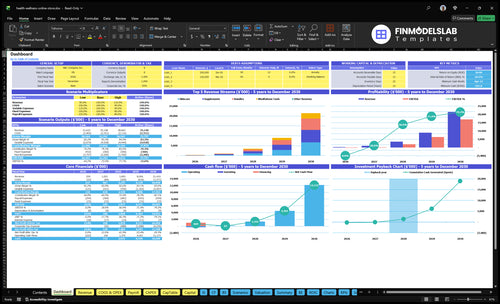
Core inputs and core outputs
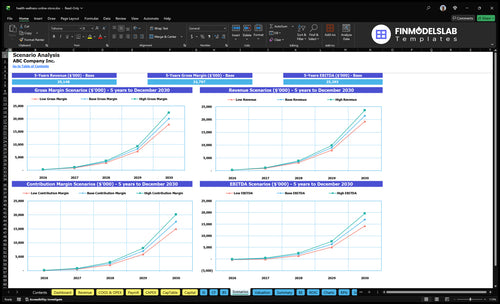
Three scenario analysis
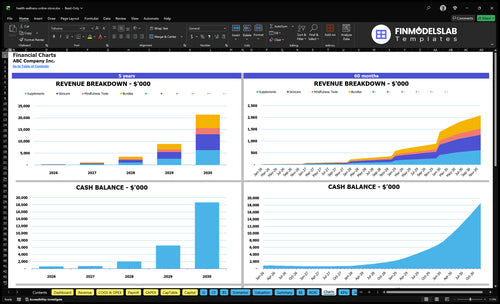
Presentation ready
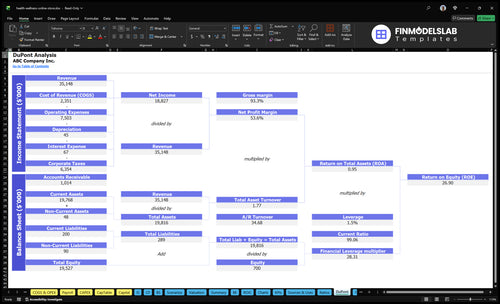
DuPont analysis
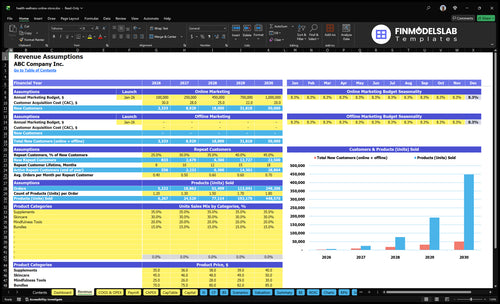
Researched revenue assumptions
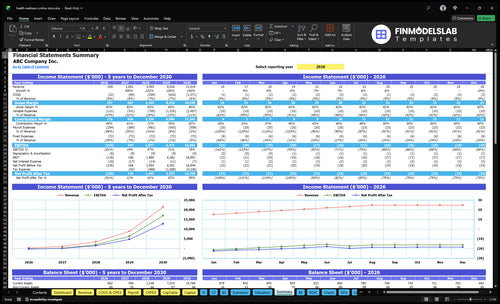
Lender-friendly financial outputs
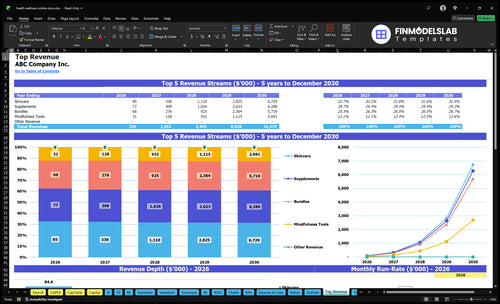
Revenue stream detailed view
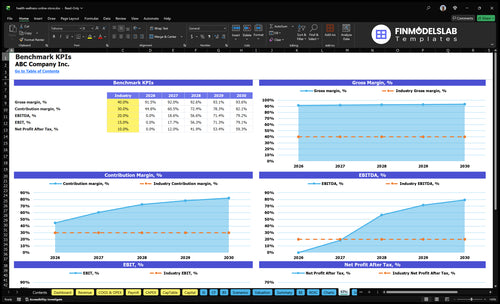
Performance metrics benchmark

The low, base, and high cases were already laid out, so I could compare outcomes without spending half a day toggling assumptions. It made the planning discussion much easier to follow.

I used to build wellness store financials by hand, and it ate up hours. This template cut that down to one afternoon and let me focus on pricing and product mix instead.
I finally had a clean view of runway and possible shortfalls, which made funding conversations a lot less stressful. One review meeting was enough to spot where cash would tighten up.