

Acquire Customers
Seasonal online and offline marketing spend is divided by each channel CAC.


This editable workbook models customer acquisition, repeat purchasing, unit sales, costs, cash flow, and five-year financial statements for an indie game studio.
Use the model to translate marketing budgets, acquisition costs, repeat-customer behavior, order volume, product mix, and pricing into a structured studio forecast.
Editable operating assumptions feed the revenue, cost, staffing, capital, scenario, and reporting schedules so changes flow through the projected financial outputs.
The model converts channel marketing spend into new customers, adds repeat-buyer cohorts, calculates orders and units, then applies category mix and prices.
Seasonal online and offline marketing spend is divided by each channel CAC.
A share of new customers becomes repeat buyers for the stated customer lifetime.
First-purchase orders combine with active repeat customers times repeat orders per month.
Orders convert to units, then the shared unit pool follows the product sales mix.
Allocated category units multiply by category prices and sum to monthly ecommerce revenue.
The Revenue sheet connects acquisition budgets and CAC with repeat-customer behavior, order volume, product mix, and category pricing.
 REVENUE
The COGS & OPEX sheet organizes direct, variable, and fixed operating assumptions that feed the studio expense forecast.
 COGS & OPEX
The Scenarios view compares alternative revenue, gross margin, contribution margin, and EBITDA paths across the five-year forecast.
 SCENARIOS
The Dashboard combines scenario controls with headline financial metrics, revenue mix, profitability, cash flow, and investment payback visuals.
 DASHBOARD
The ready-made model fits studios using this acquisition-and-repeat-sales logic; materially different monetization or operating structures may require custom modeling.
The template is a planning starting point, not a guarantee of performance.
Financial Models Lab can build or adapt a model when your revenue logic, operating schedules, or reporting requirements differ from the ready-made structure.
ORDER A CUSTOM FINANCIAL MODELAfter checkout, you receive the editable Indie Game Studio financial model for building and reviewing a five-year operating and financial forecast.
Update the model assumptions in an editable Excel workbook that can also be used with Google Sheets.
Review five-year projections with detailed operating assumptions and projected financial performance.
Compare Low, Base, and High cases through the workbook scenario analysis view.
Review projected income statement, cash flow, balance sheet, dashboard, and supporting reports.
The essential answers are visible in full, with no accordion clicks required.
It converts channel marketing spend into new customers, adds repeat-customer cohorts, calculates orders and units, then applies product mix and category prices.
You can edit launch timing, marketing budgets, seasonality, CAC, repeat behavior, units per order, product mix, and category pricing.
The Scenarios view compares Low, Base, and High paths for revenue, gross margin, contribution margin, and EBITDA across five years.
The product shows projected income statement, cash flow, balance sheet, dashboard, scenarios, summary, break-even, ROIC, charts, KPIs, and other supporting reports.
Yes. Financial Models Lab offers custom modeling when you need different revenue logic, operating schedules, or reporting structures.
It is a planning forecast based on the assumptions entered into the workbook, not a guarantee of business performance.
This download provides a comprehensive financial planning tool for independent game companies, including detailed financial statements, dashboards, and summaries.
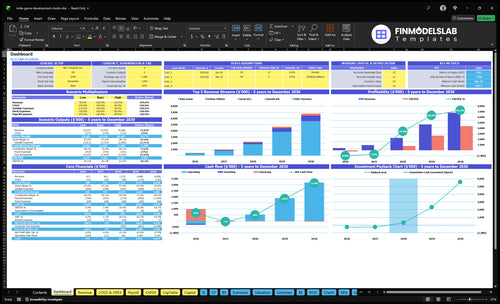
Core inputs and core outputs
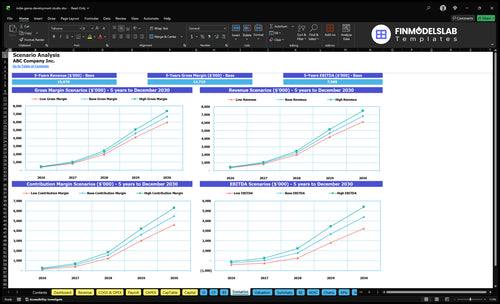
Three scenario analysis
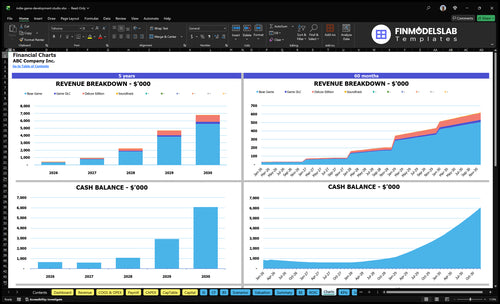
Presentation ready
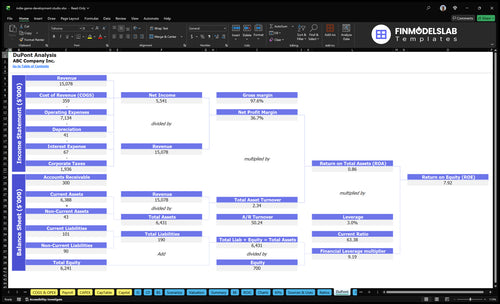
DuPont analysis
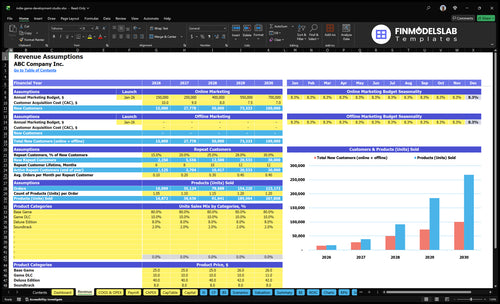
Researched revenue assumptions
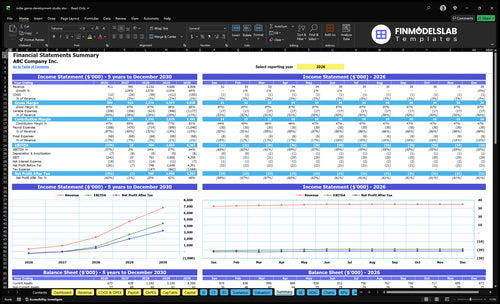
Lender-friendly financial outputs
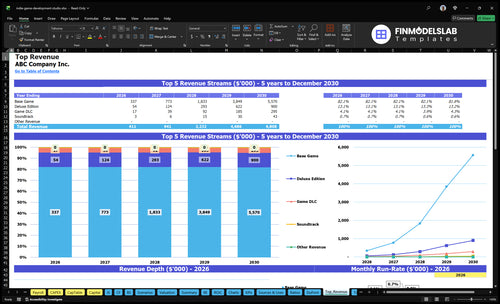
Revenue stream detailed view

Performance metrics benchmark

This template turned my pricing, cost, and growth inputs into one organized model, so I wasn’t hunting through scattered tabs. I saved about 3 hours and could explain the numbers without second-guessing them.
I’m not strong in Excel, but the layout made the model easy to follow and update. I had the forecast filled in and ready to review in under an hour.

The built-in checks made it easier to trust the file, even when I changed inputs late in the process. One bad formula would’ve thrown off the forecast, but this kept me from redoing a full day of work.