

Define Streams
Set the revenue-stream names the label wants to model independently.


This editable workbook models stream-level label revenue and costs across five years, then connects them to scenarios, statements, and management reporting.
Use the workbook to translate independent music label revenue streams, operating costs, staffing, capital needs, and financing assumptions into a structured forecast.
Editable assumptions feed the model calculations, so changes to volumes, prices, timing, costs, or scenario settings update the connected financial outputs.
Each enabled revenue stream is calculated from its independently entered volume and matching unit price, with monthly seasonality and ancillary income applied separately.
Set the revenue-stream names the label wants to model independently.
Enter units, transactions, or another measurable volume for each stream and period.
Assign the corresponding unit price to every enabled revenue stream.
Allocate annual stream revenue through monthly seasonality once and add ancillary income when used.
Sum all enabled stream revenue and any separately entered ancillary income.
The Revenue worksheet pairs each enabled revenue stream with its own volume, price, launch timing, and monthly seasonality inputs.
 REVENUE
The COGS & OPEX worksheet separates direct costs, variable expenses, and recurring overhead so cost assumptions can flow into projected results.
 COGS & OPEX
The Scenarios view compares Low, Base, and High cases across revenue, gross margin, contribution margin, and EBITDA over the forecast horizon.
 SCENARIOS
The Dashboard consolidates model setup, scenario controls, financial outputs, revenue mix, profitability, cash flow, and payback information in one view.
 DASHBOARD
The ready-made model fits labels using independent volume-and-price revenue streams; structurally different revenue logic or reporting may call for custom modeling.
The template is a planning starting point, not a guarantee of performance.
Financial Models Lab can build or adapt a model when you need different revenue logic, operating schedules, or financial reporting.
ORDER A CUSTOM FINANCIAL MODELThe purchase provides an editable Independent Music Label Financial Model for five-year forecasting, scenario comparison, statements, and management reporting.
Update revenue, cost, staffing, capital, financing, timing, and other planning assumptions.
Review projected performance across the model’s five-year planning horizon.
Compare Low, Base, and High cases through the dedicated scenario view.
Use the P&L, cash flow, balance sheet, dashboard, and related reporting views.
The essential answers are visible in full, with no accordion clicks required.
It calculates each enabled stream from independently entered volume and matching unit price, then sums stream revenue with any separately entered ancillary income.
You can edit revenue-stream names, launch dates where applicable, stream volumes or transactions, matching unit prices, monthly seasonality, and ancillary income.
The Scenarios view compares alternative cases across revenue, gross margin, contribution margin, and EBITDA over the five-year forecast.
The product page confirms a dashboard, P&L, cash flow statement, balance sheet, financial summary, and additional analysis and reporting views.
Yes. Financial Models Lab offers custom financial modeling for different revenue logic, operating schedules, or reporting requirements.
It is a planning forecast based on the assumptions entered into the workbook, not a guarantee of business performance.
This independent music business financial forecasting tool includes everything you need to build a comprehensive financial plan, from detailed assumptions and revenue modeling to complete financial statements and performance dashboards.

Core inputs and core outputs
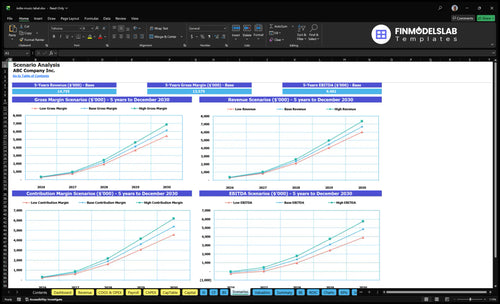
Three scenario analysis

Presentation ready

DuPont analysis
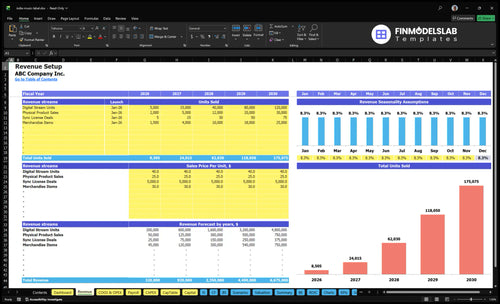
Researched revenue assumptions

Lender-friendly financial outputs
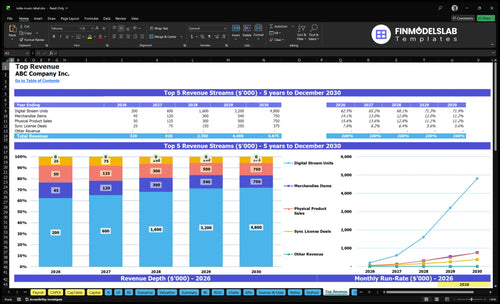
Revenue stream detailed view

Performance metrics benchmark

This template clarified what investors expect and gave me a clean structure for the first meeting. We had the financials ready in less than a day, and it was much easier to walk through the numbers without second-guessing the format.
I was juggling pricing, marketing spend, and royalty assumptions in too many places. This model pulled everything into one setup, and I could finally test scenarios without losing track of the core numbers.

Building the label’s financials by hand was taking me forever, and I still wasn’t confident in the output. Using this template cut the setup to a few hours and gave me a model I could actually share with my team.