LEATHER GOODS STORE BUSINESS PLAN
I. Executive Summary
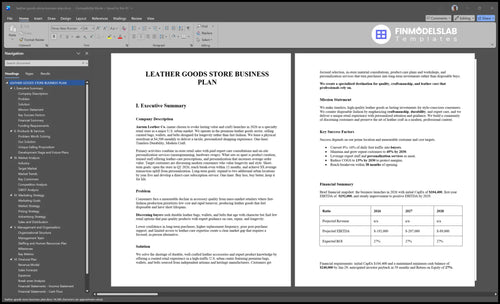
Company Description
Aurum Leather Co. (name chosen to evoke lasting value and craft) launches in 2026 as a specialty retail store in a major U.S. urban market. We operate in the premium leather goods sector, selling curated bags, wallets, and belts designed for longevity rather than fast fashion. We lease a physical storefront at $4,500 monthly to deliver a tactile, personalized shopping experience. One-liner: Timeless Durability, Modern Craft.
Primary activities combine in-store retail sales with paid expert care consultations and on-site personalization services (monogramming, hardware swaps). What sets us apart is product curation, trained staff offering leather-care prescriptions, and personalization that increases average order value. Target customers are discerning modern consumers who value longevity and style. Short-term goals: open the store in Q2 2026, reach break-even within 12 months, and achieve $X average transaction uplift from personalization. Long-term goals: expand to two additional urban locations by year five and develop a direct-care subscription service. One-liner: Buy less, buy better, keep it for life.
Problem
Consumers face a measurable decline in accessory quality from mass-market retailers where fast-fashion production prioritizes low cost and rapid turnover, producing leather goods that feel disposable and have short lifespans.
Discerning buyers seek durable leather bags, wallets, and belts that age with character but find few retail options that pair quality products with expert guidance on care, repair, and longevity.
Lower confidence in long-term purchases, higher replacement frequency, poor post-purchase support, and limited access to leather-care expertise create a clear market gap that requires a focused, in-person alternative.
Solution
We solve the shortage of durable, well-crafted leather accessories and expert product knowledge by offering a curated retail experience in a high-traffic U.S. urban center featuring premium bags, wallets, and belts sourced from independent artisans and heritage manufacturers. Customers get focused selection, in-store material consultations, product-care plans and workshops, and personalization services that turn purchases into long-term investments rather than disposable buys.
We create a specialized destination for quality, craftsmanship, and leather care that professionals rely on.
Mission Statement
We make timeless, high-quality leather goods as lasting investments for style-conscious consumers. We counter disposable fashion by emphasizing craftsmanship, durability, and expert care, and we deliver a unique retail experience with personalized attention and guidance. We build a community of discerning customers and preserve the art of leather craft in a modern, professional context.
Key Success Factors
Success depends on our prime location and measurable customer and cost targets.
-
Convert 8%–16% of daily foot traffic into buyers.
-
Maintain and grow repeat customers to 45% by 2030.
-
Leverage expert staff and personalization services as moat.
-
Reduce COGS to 13% by 2030 to protect margins.
-
Reach breakeven within 38 months of opening.
Financial Summary
Brief financial snapshot: the business launches in 2026 with initial CapEx of $104,400, first-year EBITDA of -$192,000, and steady improvement to positive EBITDA by 2029.
Ratio |
2026 |
2027 |
2028 |
Projected Revenue |
n/a |
n/a |
n/a |
Projected EBITDA |
$-192,000 |
$-207,000 |
$-89,000 |
Expected ROI |
27% |
27% |
27% |
Financial requirements: initial CapEx $104,400 and a maintained minimum cash balance of $240,000 by Jan-29; anticipated investor payback in 59 months and Return on Equity of 27%.
Outlook: losses early, breakeven Feb-2029, then material profitability (EBITDA $208k in 2029; $838k in 2030).
Funding Requirements
The business launches in 2026 with initial CapEx of USD 104,400 and a Year‑1 EBITDA of -USD 192,000, improves to USD 208,000 EBITDA in 2029 and USD 838,000 in 2030, targets a Return on Equity of 0.27 with a 59‑month investor payback, plans handbags at USD 225 by Year 5, and will maintain a minimum cash balance of USD 240,000 by Jan‑2029 to reach breakeven in Feb‑2029.
Categories |
Amount, USD |
Store renovation (capex) |
25,000 |
Initial inventory investment |
35,000 |
Launch marketing (capex) |
2,500 |
Other startup CapEx (fixtures, POS, security, equipment) |
41,900 |
Cumulative EBITDA losses (Years 1–3) |
488,000 |
Five-year staffing (manager + sales team) |
1,100,500 |
Contingency & misc capex |
0 |
Working capital |
240,000 |
Total funding required |
1,932,900 |