

Set Resources
Define practitioner or revenue-producing resource categories, counts by period, service lines, and opening or availability dates.


The Mental Health Clinic Financial Model is an editable five-year Excel and Google Sheets workbook linking practitioner capacity, utilization, pricing, scenarios, and financial statements.
Use the workbook to plan practitioner capacity, service-line availability, utilization ramps, treatment pricing, operating costs, staffing, capital needs, and financing across five years.
Editable operating assumptions feed calculations that connect service capacity to revenue, expenses, cash flow, financial statements, scenario comparisons, and management reporting.
The model calculates service capacity from practitioner resources, applies utilization, prices expected treatments, respects active months, and totals revenue across service lines.
Define practitioner or revenue-producing resource categories, counts by period, service lines, and opening or availability dates.
Multiply resource counts by maximum monthly treatments or services per resource for each revenue stream.
Apply utilization percentages or ramps to maximum capacity to estimate expected service units.
Multiply expected service units by average realized price and active months for each stream.
Sum calculated revenue across practitioners, resources, and mental health service lines for the forecast.
The Revenue worksheet organizes service lines, launch dates, practitioner counts, monthly treatment capacity, utilization, and average prices that drive modeled revenue.
 REVENUE
The COGS & OPEX worksheet separates direct service costs, variable operating expenses, and fixed overhead so cost assumptions flow into financial results.
 COGS & OPEX
The Scenarios view compares Low, Base, and High cases across revenue, gross margin, contribution margin, and EBITDA throughout the five-year clinic forecast.
 SCENARIOS
The Dashboard combines scenario controls, core financials, clinic revenue mix, profitability, cash flow, and investment payback indicators in one management view.
 DASHBOARD
The ready-made model fits capacity-driven clinic forecasting, while materially different revenue logic, operating dependencies, or reporting structures may require custom modeling.
The template is a planning starting point, not a guarantee of performance.
Financial Models Lab can build or adapt a model when you need different revenue logic, operating schedules, or financial reporting than the ready-made structure.
ORDER A CUSTOM FINANCIAL MODELAfter checkout, you receive the editable Mental Health Clinic Financial Model as an instant download with five-year projections, Low/Base/High scenarios, dashboard reporting, and linked financial statements.
Work in the fully editable Excel or Google Sheets workbook after instant download.
Connect practitioner capacity, utilization, service pricing, operating costs, staffing, and timing assumptions with financial results over five years.
Compare Low, Base, and High cases to see how alternative assumptions change modeled outcomes.
Review the Dashboard together with Income Statement, Cash Flow, Balance Sheet, Summary, and chart outputs.
The essential answers are visible in full, with no accordion clicks required.
It calculates maximum service units from practitioner or resource counts and monthly capacity, applies utilization, multiplies expected services by price and active months, then totals revenue across service lines.
You can edit practitioner or resource categories and counts, opening dates, maximum monthly treatments or services, utilization, average prices, active months, service lines, and seasonality when present.
You can compare how Low, Base, and High cases change revenue, gross margin, contribution margin, and EBITDA across the five-year forecast.
The workbook includes Dashboard, Summary, Income Statement, Cash Flow, Balance Sheet, Scenarios, Charts, and other visible reporting tabs.
Yes. Financial Models Lab offers custom financial modeling when you need different revenue logic, operating schedules, or reporting structures.
It is a planning forecast based on editable assumptions, not a guarantee of business performance, financing, profitability, or returns.
This package includes a comprehensive, five-year mental health clinic financial model template compatible with both Excel and Google Sheets, complete with a dynamic dashboard and investor-ready reports.
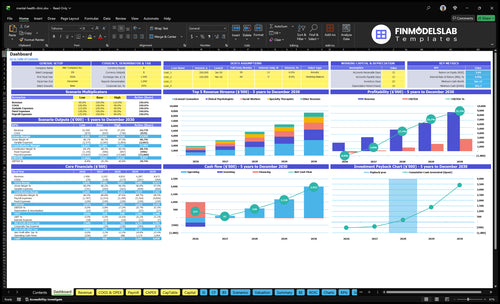
Core inputs and core outputs
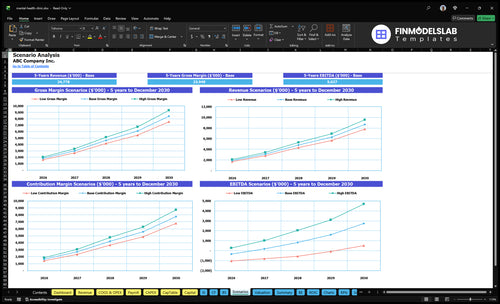
Three scenario analysis
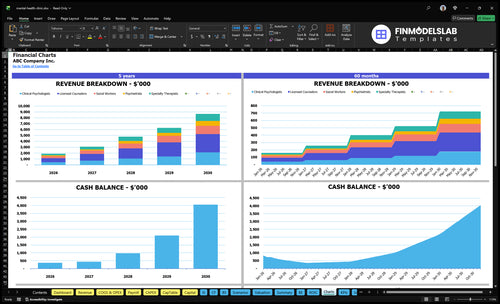
Presentation ready
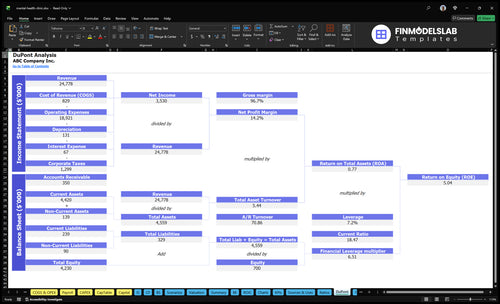
DuPont analysis
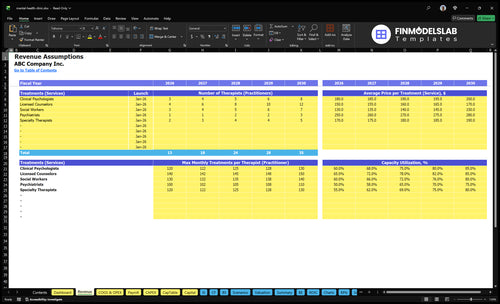
Researched revenue assumptions

Lender-friendly financial outputs
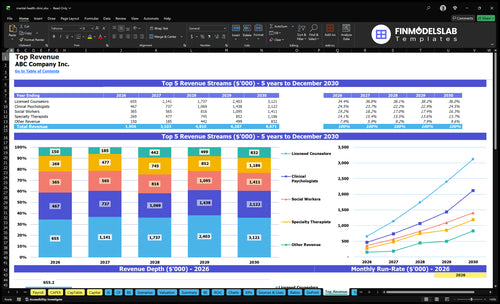
Revenue stream detailed view
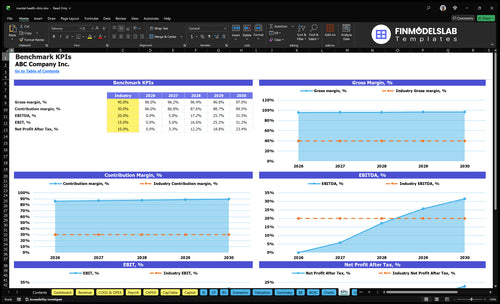
Performance metrics benchmark

This template helped me organize pricing, costs, and growth assumptions in one place instead of chasing them across tabs. I had a clean model ready to review in under a day.
I was building the clinic financials by hand and it was taking forever. With this template, I cut my planning time by more than half and got to a usable forecast the same afternoon.

I could finally see where the clinic would make money and where it wouldn’t. The break-even view made the margin story clear enough to walk through in a meeting without second-guessing the numbers.