

Acquire Customers
Divide each channel budget by its CAC, then combine online and offline customers.


This editable five-year Excel workbook forecasts homeware ecommerce sales from customer acquisition, repeat buying, product mix, pricing, costs, and three-statement outputs.
Use the model to translate your customer acquisition plan, repeat purchasing assumptions, product mix, prices, and cost structure into a five-year financial forecast.
Editable operating assumptions feed monthly and annual calculations, Low/Base/High cases, financial statements, and management reporting views without rebuilding the workbook structure.
The model converts channel marketing spend into customers, repeat cohorts, orders, units, category allocation, and priced product sales for each forecast month.
Divide each channel budget by its CAC, then combine online and offline customers.
Apply repeat-buyer percentage, cohort lifetime, and repeat-order frequency to active customers.
Add new-customer first orders to active repeat customers multiplied by repeat-order frequency.
Multiply orders by units per order, then allocate units by category sales mix.
Multiply category units by category prices and sum revenue across categories and months.
The Revenue view links marketing budgets, CAC, repeat behavior, order volume, product mix, and category prices to the ecommerce sales forecast.
 REVENUE
The COGS & OPEX worksheet organizes direct costs, variable expenses, and fixed operating expenses that feed the monthly forecast and financial statements.
 COGS & OPEX
The Scenarios view compares Low, Base, and High outcomes for revenue, margins, and EBITDA so assumption changes can be reviewed side by side.
 SCENARIOS
The Dashboard combines model setup, scenario controls, financial outputs, revenue mix, profitability, cash flow, and investment payback charts in one view.
 DASHBOARD
This ready-made structure fits ecommerce homeware planning using customer acquisition, repeat cohorts, product mix, and category pricing; different operating logic may require custom work.
The template is a planning starting point, not a guarantee of performance.
Financial Models Lab can build or adapt a model when you need different revenue logic, operating schedules, or financial reporting.
ORDER A CUSTOM FINANCIAL MODELYou receive an instantly downloadable, fully editable Excel financial model with five-year monthly and annual projections, scenarios, financial statements, and reporting views.
Update the model's revenue, cost, staffing, capital, and global planning assumptions.
Review detailed monthly and annual projections across the five-year planning horizon.
Compare Low, Base, and High cases using the model's scenario framework.
Review the income statement, cash flow, balance sheet, dashboard, and supporting reports.
The essential answers are visible in full, with no accordion clicks required.
It converts channel marketing spend and CAC into customers, models repeat cohorts and orders, allocates units by product mix, and applies category prices.
You can edit launch timing, marketing budgets and seasonality, CAC, repeat behavior, units per order, category mix, and category prices.
You can compare modeled revenue, gross margin, contribution margin, and EBITDA trajectories across the three cases.
The workbook includes an income statement, cash flow statement, balance sheet, dashboard, summary, scenarios, and additional analysis reports.
Yes. Financial Models Lab can build or adapt a model when different revenue logic, operating schedules, or financial outputs are required.
It is a planning forecast based on editable assumptions, not a guarantee of business performance or financial results.
You get a complete, pre-built excel financial model for your homeware startup, including detailed financial statements, a dynamic dashboard, and fully editable assumptions.
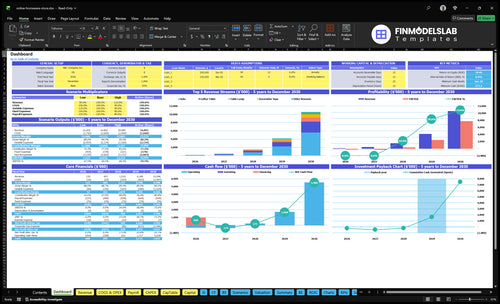
Core inputs and core outputs
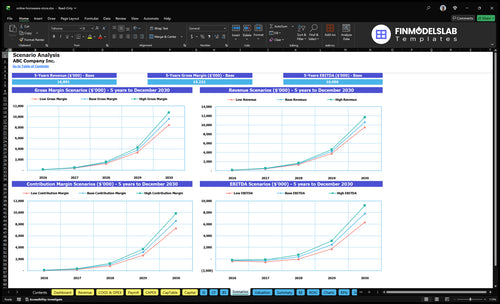
Three scenario analysis
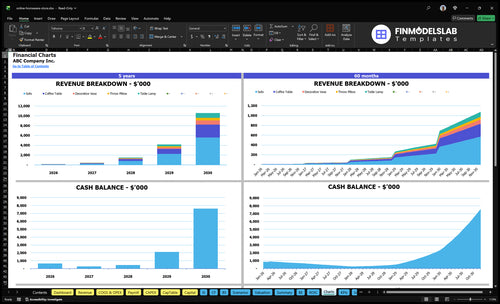
Presentation ready
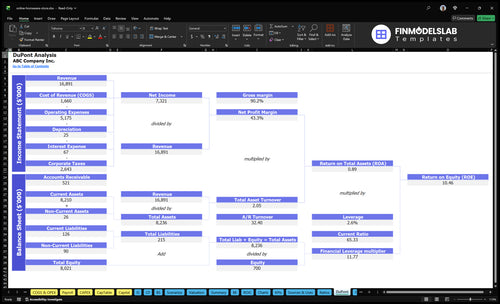
DuPont analysis
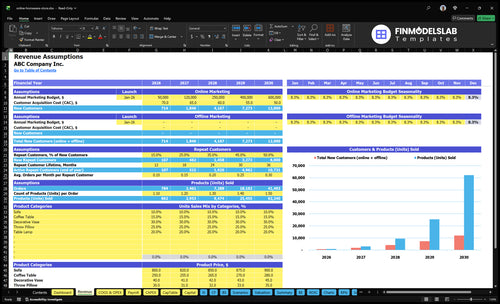
Researched revenue assumptions
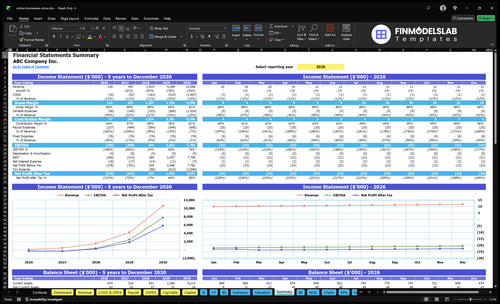
Lender-friendly financial outputs
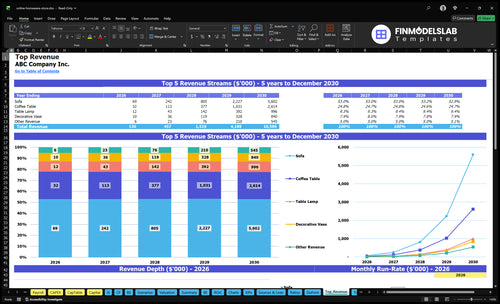
Revenue stream detailed view
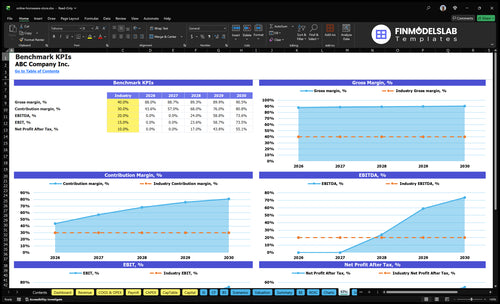
Performance metrics benchmark

This template made cash-flow uncertainty much easier to manage, with monthly projections that showed where shortfalls could hit. I saved about 6 hours of spreadsheet work and had a clearer runway plan for my lender meeting.
Starting from scratch felt overwhelming, but this model gave me a clean structure to work from right away. I had a full first draft in under 2 hours instead of spending a whole weekend guessing what to build.

The profitability view helped me spot margin gaps and break-even timing without digging through formulas. I was able to tighten assumptions and share a cleaner forecast with my partner the same day.