ONLINE THRIFT STORE BUSINESS PLAN
I. Executive Summary
Company Description
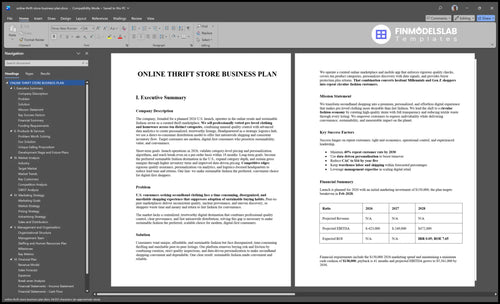
The company, founded for a planned 2026 U.S. launch, operates in the online resale and sustainable fashion sector as a curated thrift marketplace. We sell professionally vetted pre-loved clothing and homeware across ten distinct categories, combining manual quality control with advanced data analytics to create personalized, trustworthy listings. Headquartered in a strategic logistics hub, we use a direct-to-consumer distribution model to offer fast nationwide shipping and consistent inventory flow. Target customers are modern, digital-first consumers who prioritize sustainability, value, and convenience.
Short-term goals: launch operations in 2026, validate category-level pricing and personalization algorithms, and reach break-even on a per-order basis within 18 months. Long-term goals: become the preferred sustainable fashion destination in the U.S., expand category depth, and sustain gross margins through higher inventory turns and improved data-driven pricing. Competitive edges: rigorous quality assurance, personalization via analytics, and logistics-focused headquarters to reduce lead time and returns. One line: we make sustainable fashion the preferred, convenient choice for digital-first shoppers.
Problem
U.S. consumers seeking secondhand clothing face a time-consuming, disorganized, and unreliable shopping experience that suppresses adoption of sustainable buying habits. Peer-to-peer marketplaces deliver inconsistent quality, unclear provenance, and uneven discovery, so shoppers waste time and money and return to fast fashion for convenience.
The market lacks a centralized, trustworthy digital destination that combines professional quality control, clear provenance, and fast nationwide distribution; solving this gap is necessary to make sustainable fashion the preferred, scalable choice for modern, digital-first consumers.
Solution
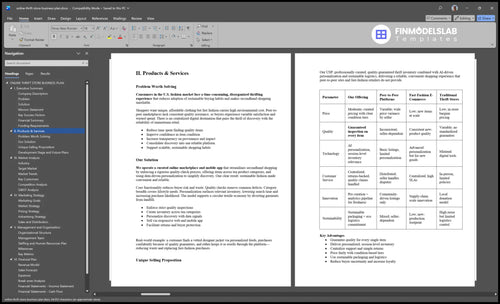
Consumers want unique, affordable, and sustainable fashion but face disorganized, time-consuming thrifting and unreliable peer-to-peer listings. Our platform removes buying risk and friction by combining curation, strict quality inspections, and data-driven personalization to make secondhand shopping convenient and dependable. One clear result: sustainable fashion made convenient and reliable.
We operate a curated online marketplace and mobile app that enforces rigorous quality checks, covers ten product categories, personalizes discovery with data signals, and provides buyer protection plus returns. That combination converts hesitant Millennials and Gen Z shoppers into repeat circular-fashion customers.
Mission Statement
We transform secondhand shopping into a premium, personalized, and effortless digital experience that makes pre-loved clothing more desirable than fast fashion. We lead the shift to a circular fashion economy by curating high-quality items with full transparency and reducing textile waste through every listing. We empower customers to express individuality while delivering convenience, sustainability, and measurable impact on the planet.
Key Success Factors
Success hinges on repeat customers, tight unit economics, operational control, and experienced leadership.
-
Maintain 40% repeat customer rate by 2030
-
Use data-driven personalization to boost turnover
-
Reduce CAC to $16 by year five
-
Keep warehouse labor and shipping within forecasted percentages
-
Leverage management expertise in scaling digital retail
Financial Summary
Launch is planned for 2026 with an initial marketing investment of $150,000; the plan targets breakeven in Feb-2028.
Ratio |
2026 |
2027 |
2028 |
Projected Revenue |
N/A |
N/A |
N/A |
Projected EBITDA |
$-423,000 |
$-249,000 |
$472,000 |
Expected ROI |
N/A |
N/A |
IRR 0.05; ROE 7.65 |
Financial requirements include the $150,000 2026 marketing spend and maintaining a minimum cash cushion of $138,000; payback is 41 months and projected EBITDA grows to $5,561,000 by 2030.
Overall outlook: losses early, clear path to profitability by 02/2028 and strong cash-positive growth thereafter.
Funding Requirements
We need funding of $1,044,000 to cover product CapEx, the first two years of operational losses, the full 2026 marketing plan, and a minimum cash reserve.
Categories |
Amount, USD |
Product Development / Technology (CapEx) |
$84,000 |
Marketing (Annual 2026 budget) |
$150,000 |
Operational losses (Cumulative negative EBITDA, Y1–Y2) |
$672,000 |
Operations / Warehouse infrastructure |
$0 |
Staffing |
$0 |
Other |
$0 |
Working capital |
$138,000 |
Total funding required |
$1,044,000 |
Launch planned for 2026 with a $150,000 marketing spend, CAC $25, year‑one EBITDA loss $423,000, breakeven February 1, 2028, forecasted 2030 EBITDA $5,561,000, ROE 7.65, IRR 0.05, and a maintained minimum cash reserve of $138,000.