PAKISTANI RESTAURANT BUSINESS PLAN
I. Executive Summary
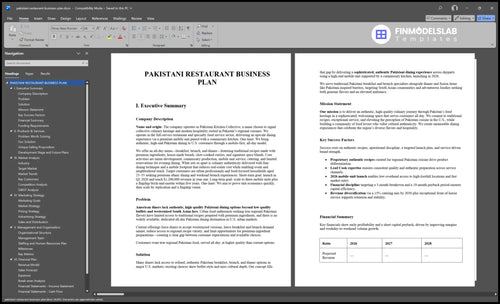
Company Description
Name and origin: The company operates as Pakistani Kitchen Collective, a name chosen to signal collective culinary heritage and modern hospitality rooted in Pakistan’s regional cuisines. We operate in the full-service restaurant and specialty food service sector, delivering an upscale dining experience via a premium mobile unit paired with a commissary kitchen. One-liner: We bring authentic, high-end Pakistani dining to U.S. customers through a mobile-first, all-day model.
We offer an all-day menu—breakfast, brunch, and dinner—featuring traditional recipes made with premium ingredients, house-made breads, slow-cooked curries, and signature spice blends. Core activities are menu development, commissary production, mobile unit service, catering, and limited reservations for evening dining. What sets us apart is culinary authenticity delivered with fine-dining technique and a mobile footprint that reduces real-estate cost while enabling event and neighborhood reach. Target customers are urban professionals and food-focused households aged 25–55 seeking premium ethnic dining and weekend brunch experiences. Short-term goal: launch in Q2 2026 and reach $1,200,000 revenue in year one. Long-term goal: scale to three mobile units plus a flagship brick-and-mortar within five years. One-liner: We aim to prove unit economics quickly, then scale by replication and a flagship venue.
Problem
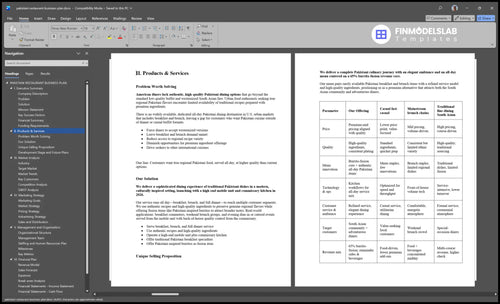
American diners lack authentic, high-quality Pakistani dining options beyond low-quality buffets and westernized South Asian fare. Urban food enthusiasts seeking true regional Pakistani flavors have limited access to traditional recipes prepared with premium ingredients, and there is no widely available, dedicated all-day Pakistani dining destination in U.S. urban markets.
Current offerings force diners to accept westernized versions, leave breakfast and brunch demand unmet, reduce access to regional recipe variety, and limit opportunities for premium-ingredient preparations—creating a clear gap between customer expectations and available choices.
Customers want true regional Pakistani food, served all day, at higher quality than current options.
Solution
Many diners lack access to refined, authentic Pakistani breakfast, brunch, and dinner options in major U.S. markets; existing choices skew buffet-style and miss cultural depth. Our concept fills that gap by delivering a sophisticated, authentic Pakistani dining experience across dayparts using a high-end mobile unit supported by a commissary kitchen, launching in 2026.
We serve traditional Pakistani breakfast and brunch specialties alongside dinner and fusion items like Pakistani-inspired burritos, targeting South Asian communities and adventurous foodies seeking both genuine flavors and an elevated ambiance.
Mission Statement
Our mission is to deliver an authentic, high-quality culinary journey through Pakistan’s food heritage in a sophisticated, welcoming space that serves customers all day. We commit to traditional recipes, exceptional service, and elevating the perception of Pakistani cuisine in the U.S., while building a community of food lovers who value cultural authenticity. We create memorable dining experiences that celebrate the region’s diverse flavors and hospitality.
Key Success Factors
Success rests on authentic recipes, operational discipline, a targeted launch plan, and service-driven brand strength.
-
Proprietary authentic recipes curated for regional Pakistani cuisine drive product differentiation.
-
Lead Cook expertise ensures consistent quality and authentic preparation across service channels.
-
2026 mobile-unit launch enables low-overhead access to high-footfall locations and fast market entry.
-
Financial discipline targeting a 3-month breakeven and a 19-month payback period ensures capital efficiency.
-
Revenue diversification via a 15% catering mix by 2030 plus exceptional front-of-house service supports retention and stability.
Financial Summary
Key financials show early profitability and a short capital payback, driven by improving margins and weekday-to-weekend volume growth.
Ratio |
2026 |
2027 |
2028 |
Projected Revenue |
— |
— |
— |
Projected EBITDA |
$141,000 |
$239,000 |
$341,000 |
Expected ROI |
ROE 1.81 (return on equity) |
IRR 0.07 (internal rate of return) |
Payback 19 months (on $169,000) |
Financial requirements: $169,000 initial capital; Anticipated return: 19-month payback, ROE 1.81, IRR 0.07.
Outlook: profitable from year one with improving COGS (14% to 11.5%) and EBITDA rising to $655,000 by year five.
Funding Requirements
The project needs capital deployed before operations begin in 2026.
Categories |
Amount, USD |
Food Truck Purchase (primary mobile unit) |
120,000 |
Commercial Kitchen Equipment |
30,000 |
POS System Hardware |
2,500 |
Generator & Power Inverter |
4,000 |
Truck Wrap & Branding (initial marketing) |
7,500 |
Initial Smallwares & Utensils |
1,800 |
Website & Online Ordering Setup |
2,000 |
Initial Permits & Licensing Fees |
1,200 |
Working capital (first 3 months fixed expenses) |
11,175 |
Total funding required |
180,175 |
Projected Year 1 EBITDA $141,000 scaling to $655,000 by Year 5; 19‑month payback on the stated $169,000 initial capital; Saturday covers grow from 150 to 300 by 2030; ROE 1.81; IRR 0.07; COGS improving from 14% to 11.5% of sales.