

Acquire Customers
Divide each channel's marketing spend by its CAC, then add online and offline new customers.


This editable five-year Excel or Google Sheets workbook models monthly personalized children's book sales from customer acquisition, repeat-customer cohorts, orders, product mix, pricing, and linked financial reports.
Use the workbook to translate marketing budgets, channel CAC, repeat-customer behavior, order volume, book mix, and category prices into a five-year personalized children's books forecast.
Editable assumptions flow through revenue, COGS and operating expenses, scenarios, and financial statements so changes can be reviewed across the model.
Revenue starts with channel marketing spend and CAC, then adds repeat-customer orders, units per order, book-category sales mix, and category prices.
Divide each channel's marketing spend by its CAC, then add online and offline new customers.
Convert a share of new customers into repeat buyers and keep each cohort active for its stated lifetime.
Add first-purchase orders to active repeat customers multiplied by average repeat orders per month.
Multiply orders by units per order, then allocate the shared unit pool by product-category sales mix.
Multiply allocated category units by matching prices and sum category revenue across products and months.
The Revenue sheet connects launch timing, channel budgets, acquisition seasonality, CAC, repeat-customer behavior, order frequency, units per order, book mix, and category pricing to monthly sales.
 REVENUE
The COGS & OPEX sheet separates printing and packaging costs, variable selling expenses, and recurring fixed overhead across monthly projections.
 COGS & OPEX
The Scenarios view compares Low, Base, and High revenue, gross margin, contribution margin, and EBITDA paths across the five-year forecast.
 SCENARIOS
The Dashboard combines setup controls, scenario multipliers, headline financials, revenue mix, profitability, cash flow, and investment payback in one management view.
 DASHBOARD
The ready-made workbook fits personalized children's books ecommerce operations using the supplied customer-and-product logic; structurally different revenue engines or schedules may require custom modeling.
The template is a planning starting point, not a guarantee of performance.
Financial Models Lab can build or adapt a model when your revenue logic, operating schedules, or required reporting differs from the ready-made structure.
ORDER A CUSTOM FINANCIAL MODELAfter checkout, you receive an editable Excel or Google Sheets financial model with five-year forecasts, Low/Base/High scenario analysis, and linked financial reports.
Update operating and financial assumptions throughout the pre-built spreadsheet model.
Review five years of projections with detailed monthly and annual financial reporting.
Compare Low, Base, and High cases through the workbook's scenario controls and charts.
Review the income statement, cash flow, balance sheet, summary, and dashboard outputs.
The essential answers are visible in full, with no accordion clicks required.
It calculates new customers by channel, adds active repeat-customer orders, converts orders to units, allocates sales mix, and multiplies category units by prices.
You can edit launch timing, channel budgets and seasonality, CAC, repeat-buyer rate and lifetime, repeat ordering, units per order, sales mix, and category prices.
The Scenarios view compares Low, Base, and High paths for revenue, gross margin, contribution margin, and EBITDA across the five-year forecast.
The workbook includes income statement, cash flow, balance sheet, summary, Dashboard, break-even, ROIC, valuation, ratios, charts, KPIs, and scenario analysis.
Yes. Financial Models Lab can build or adapt a model when you need different revenue logic, operating schedules, or reporting.
It is a financial forecast driven by editable assumptions, not a guarantee of business performance, profitability, funding, or returns.
This Excel financial model for a personalized children's book startup provides everything you need in one place, from revenue forecasting to cash flow analysis and business valuation.
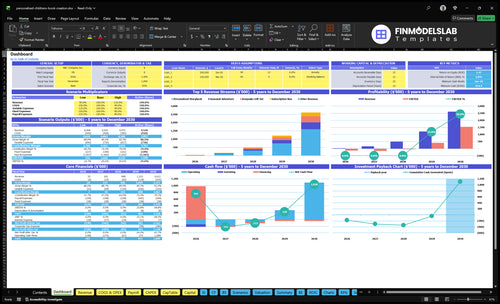
Core inputs and core outputs
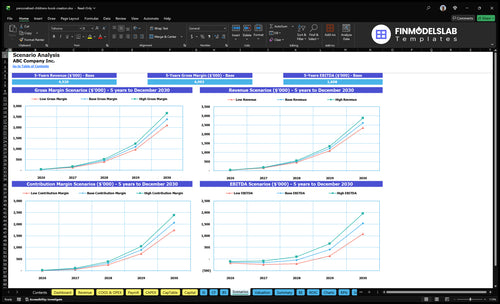
Three scenario analysis
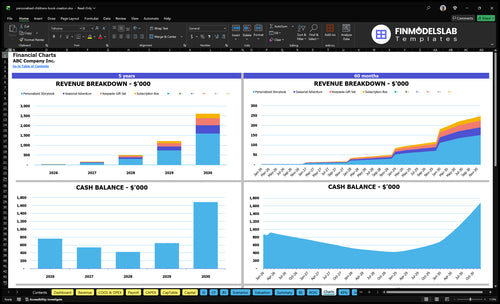
Presentation ready
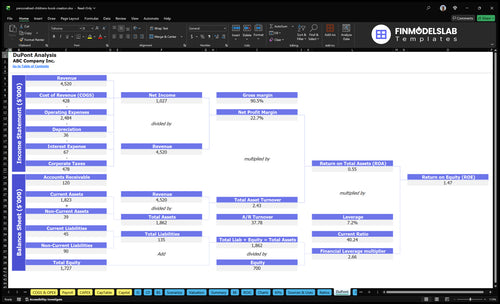
DuPont analysis
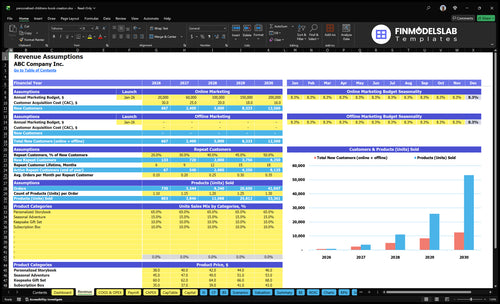
Researched revenue assumptions
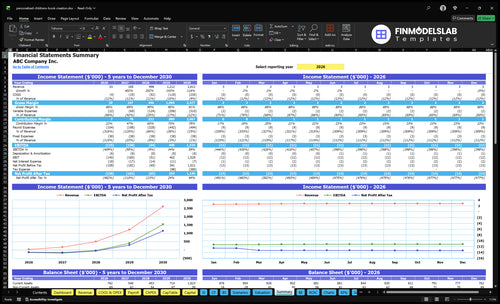
Lender-friendly financial outputs
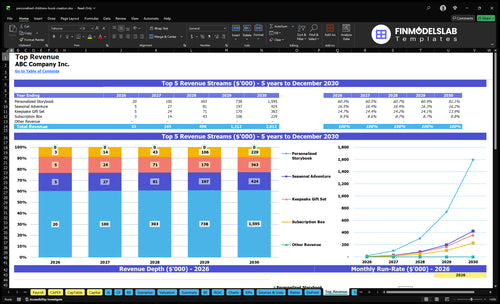
Revenue stream detailed view
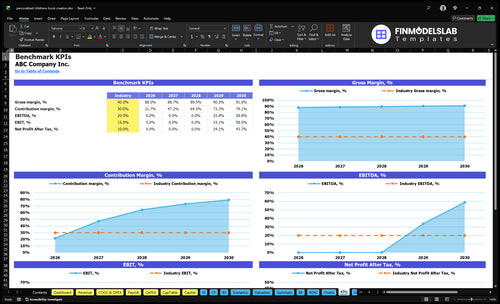
Performance metrics benchmark

This template pulled my pricing, costs, and growth inputs into one place, so I stopped bouncing between tabs and notes. It made the assumptions easier to explain and probably saved me 5+ hours of cleanup.

I didn’t have to build the financials by hand, which saved me most of a day and got me to a working draft much faster. The sheet layout was easy to follow, so I could focus on the business instead of the spreadsheet.
Low, base, and high cases were already set up, so I wasn’t rebuilding the same model three times. That made scenario planning much clearer and cut out a lot of back-and-forth.