ROBOT COFFEE SHOP BUSINESS PLAN
I. Executive Summary
Company Description
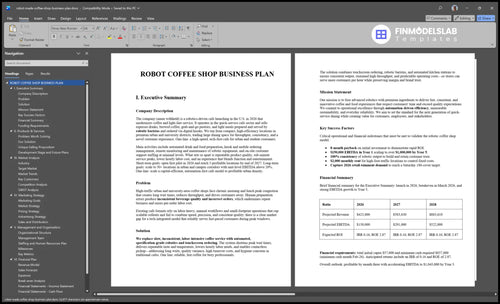
The company (name withheld) is a robotics-driven cafe launching in the U.S. in 2026 that modernizes coffee and light-fare service. It operates in the quick-service cafe sector and sells espresso drinks, brewed coffee, grab-and-go pastries, and light meals prepared and served by robotic baristas and ordered via digital kiosks. We run from compact, high-efficiency locations in premium urban and university districts, trading large dining space for throughput, consistency, and a novel customer experience. One-line: a high-speed, tech-first cafe for urban and student customers.
Main activities include automated drink and food preparation, kiosk and mobile ordering management, remote monitoring and maintenance of robotic equipment, and on-site customer support staffing at minimal levels. What sets us apart is repeatable product quality, sub-minute service peaks, lower hourly labor cost, and an experience that blends function and entertainment. Short-term goals: open first pilot in 2026 and reach 3 profitable locations by end of 2027. Long-term goals: scale to 50+ locations in urban and campus corridors with unit-level EBITDA above 20%. One-line: scale a capital-efficient, automation-first cafe model to profitable urban density.
Problem
High-traffic urban and university-area coffee shops face chronic morning and lunch peak congestion that creates long wait times, reduces throughput, and drives customers away. Human preparation errors produce inconsistent beverage quality and incorrect orders, which undermines repeat business and raises per-order labor cost.
Existing cafe formats rely on labor-heavy, manual workflows and small-footprint operations that cap scalable rollouts and fail to combine speed, precision, and consistent quality; there is a clear market gap for a tech-integrated model that reliably serves fast-paced customers during peak windows.
Solution
We replace slow, inconsistent, labor‑intensive coffee service with automated, specification‑grade robotics and touchscreen ordering. The system shortens peak wait times, delivers repeatable taste and temperature, lowers hourly labor needs, and enables contactless pickup—addressing long waits, quality variance, high turnover costs, and hygiene concerns in traditional cafes. One line: reliable, fast coffee for busy professionals.
The solution combines touchscreen ordering, robotic baristas, and automated kitchen stations to ensure consistent output, sustained high throughput, and predictable operating costs—so stores can serve more customers per hour while preserving margin and brand trust.
Mission Statement
Our mission is to fuse advanced robotics with premium ingredients to deliver fast, consistent, and innovative coffee and food experiences that respect customers' time and exceed quality expectations. We commit to operational excellence through automation-driven efficiency, measurable sustainability, and everyday reliability. We aim to set the standard for the next generation of quick-service dining while creating value for customers, employees, and stakeholders.
Key Success Factors
Critical operational and financial milestones that must be met to validate the robotic coffee shop model.
-
8-month payback on initial investment to demonstrate rapid ROI.
-
$150,000 EBITDA in Year 1 scaling to over $1,000,000 by Year 5.
-
100% consistency of robotic output to build and retain customer trust.
-
$2,000 monthly rent for high-foot-traffic locations to control fixed costs.
-
Capture 2026 retail-tainment demand to reach a Saturday 180-cover target.
Financial Summary
Brief financial summary for the Executive Summary: launch in 2026, breakeven in March 2026, and strong EBITDA growth to Year 5.
Ratio |
2026 |
2027 |
2028 |
Projected Revenue |
$423,800 |
$583,830 |
$883,610 |
Projected EBITDA |
$150,000 |
$291,000 |
$522,000 |
Expected ROI |
IRR 0.16; ROE 2.87 |
IRR 0.16; ROE 2.87 |
IRR 0.16; ROE 2.87 |
Financial requirements: total initial capex $57,000 and minimum cash required $837,000 (minimum cash month Feb-26). Anticipated returns include an IRR of 0.16 and ROE of 2.87.
Overall outlook: profitable by month three with accelerating EBITDA to $1,043,000 by Year 5.
Funding Requirements
The project requires USD 894,000 to launch in a high-traffic urban location, reach breakeven in March 2026, deliver Year 1 EBITDA of USD 150,000 and Year 5 EBITDA of USD 1,043,000, with an IRR of 0.16, Return on Equity of 2.87, and average order values of USD 10.00 midweek and USD 12.00 on weekends.
Categories |
Amount, USD |
Product Development |
0 |
Marketing |
0 |
Operations |
0 |
Staffing |
0 |
Capital Expenditures (equipment) |
57,000 |
Smallwares & Utensils |
1,500 |
POS Hardware |
2,500 |
Refrigeration |
4,000 |
Display Warmer |
3,000 |
Commercial Fryer |
8,000 |
Dough Mixer & Extruder |
6,000 |
Churro Kiosk Structure |
30,000 |
Initial Signage & Branding |
2,000 |
Working capital |
837,000 |
Total funding required |
894,000 |