SCOOTER STORE BUSINESS PLAN
I. Executive Summary
Company Description
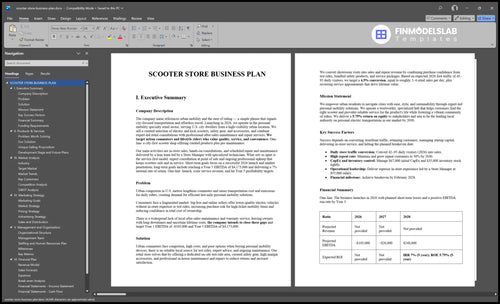
The company name references urban mobility and the ease of riding — a simple phrase that signals city-focused transportation and effortless travel. Launching in 2026, we operate in the personal mobility specialty retail sector, serving U.S. city dwellers from a high-visibility urban location. We sell a curated selection of electric and kick scooters, safety gear, and accessories, and combine expert-led retail consultations with professional after-sales maintenance and repair services. We target urban commuters and lifestyle riders who value quality, service, and convenience. One-line: a city-first scooter shop offering curated products plus pro maintenance.
Our main activities are in-store sales, hands-on consultations, and scheduled repair and maintenance delivered by a lean team led by a Store Manager with specialized technicians. What sets us apart is the service-first model: expert consultation at point of sale and ongoing professional upkeep that keeps scooters safe and in service. Short-term goals focus on a successful 2026 launch and market penetration; long-term goals include reaching a Year 5 EBITDA of $4,173,000 and delivering a 7% internal rate of return. One-line: launch, scale service revenue, and hit Year 5 profitability targets.
Problem
Urban congestion in U.S. metros lengthens commutes and raises transportation cost and emissions for daily riders, creating demand for efficient last-mile personal mobility solutions.
Consumers face a fragmented market: big-box and online sellers offer lower-quality electric vehicles without in-store expertise or test rides, increasing purchase risk for high-ticket mobility items and reducing confidence in total cost of ownership.
There is a widespread lack of local after-sales maintenance and warranty service, leaving owners with long downtimes and uncertain lifetime costs; the company intends to close these gaps and target Year 1 EBITDA of -$103,000 and Year 5 EBITDA of $4,173,000.
Solution
Urban commuters face congestion, high costs, and poor options when buying personal mobility devices; there is no reliable local source for test rides, expert advice, and ongoing maintenance. Our retail store solves that by offering a dedicated on-site test-ride area, curated safety gear, high-margin accessories, and professional in-house maintenance and repairs to reduce returns and increase satisfaction.
We convert showroom visits into sales and repeat revenue by combining purchase confidence from test rides, bundled safety products, and service packages. Based on expected 2026 foot traffic of 45–95 daily visitors, we target a 4.5% conversion, equal to roughly 2–4 retail sales per day, plus recurring service appointments that drive lifetime value.
Mission Statement
We empower urban residents to navigate cities with ease, style, and sustainability through expert-led personal mobility solutions. We operate a trustworthy, specialized hub that helps customers find the right scooter and provides reliable service for the product's life while fostering a vibrant community of riders. We deliver a 5.75% return on equity to stakeholders and aim to be the leading local authority on personal electric transportation in our market by 2030.
Key Success Factors
Success depends on converting storefront traffic, retaining customers, managing startup capital, delivering in-store service, and hitting the planned breakeven date.
-
Daily store traffic conversion: Convert 42–95 daily visitors (2026) into sales.
-
High repeat rate: Maintain and grow repeat customers to 50% by 2030.
-
CapEx and inventory control: Manage $67,000 initial CapEx and $35,000 inventory stock tightly.
-
Operational leadership: Deliver superior in-store experience led by a Store Manager at $55,000 salary.
-
Financial milestone: Achieve breakeven by February 2028.
Financial Summary
One-line: The business launches in 2026 with planned short-term losses and a positive EBITDA run-rate by Year 3.
Ratio |
2026 |
2027 |
2028 |
Projected Revenue |
Not provided |
Not provided |
Not provided |
Projected EBITDA |
−$103,000 |
−$26,000 |
$248,000 |
Expected ROI |
Not provided |
Not provided |
IRR 7% (5-year); ROE 5.75% (5-year) |
Financial requirements: maintain a minimum cash reserve of $701,000; initial investment payback in 38 months; breakeven expected Feb-2028 (month 26).
Outlook: the plan moves from a Year 1 EBITDA loss to sustained profitability by Year 3, delivering a measured five-year IRR of 7%.
Funding Requirements
We need immediate capital of $768,000 to fund build-out, inventory, operating shortfalls, wages, and a minimum cash bridge to reach breakeven in Feb-2028.
Categories |
Amount, USD |
Capital expenditures (store build-out and initial inventory) |
$67,000 |
Operating shortfall — EBITDA Year 1 |
$103,000 |
Operating shortfall — EBITDA Year 2 |
$26,000 |
Lease (monthly) |
$3,500 |
Year 1 wages (staffing) |
$87,000 |
Other operational reserves |
$0 |
Working capital |
$701,000 |
Total funding required |
$768,000 |
Financial snapshot: launch 2026, Year 1 EBITDA −$103,000, Year 3 EBITDA $248,000, Year 5 EBITDA $4,173,000, 14.8% conversion, 1.6 units/order, 7% IRR, 5.75% ROE, 38-month payback, and a maintained minimum cash reserve of $701,000.