SUSTAINABLE BAMBOO CLOTHING BUSINESS PLAN
I. Executive Summary
Company Description
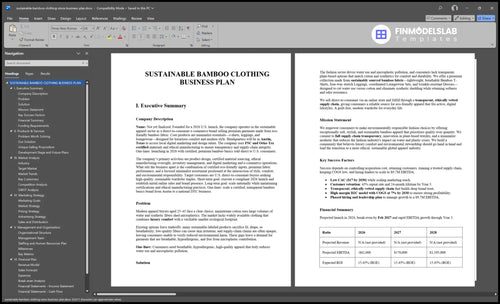
Name: Not yet finalized. Founded for a 2026 U.S. launch, the company operates in the sustainable apparel sector as a direct-to-consumer e-commerce brand selling premium garments made from eco-friendly bamboo fabric. Core products are minimalist essentials—t-shirts, leggings, and loungewear—designed for luxurious comfort and modern style. Headquarters will be in Austin, Texas to access local digital marketing and design talent. The company uses FSC and Oeko-Tex certified materials and ethical manufacturing to ensure transparency and supply-chain integrity. One-liner: launching in 2026 with certified, premium bamboo basics sold direct to U.S. consumers.
The company’s primary activities are product design, certified material sourcing, ethical manufacturing oversight, inventory management, and digital marketing and e-commerce operations. What sets the business apart is the combination of certified eco-friendly inputs, premium fabric performance, and a focused minimalist assortment positioned at the intersection of style, comfort, and environmental responsibility. Target customers are U.S. direct-to-consumer buyers seeking high-quality, sustainable wardrobe staples. Short-term goal: execute a compliant 2026 launch and establish initial online sales and brand presence. Long-term goal: scale nationally while maintaining certifications and ethical manufacturing practices. One-liner: scale a certified, transparent bamboo basics brand from Austin to a national DTC business.
Problem
Modern apparel buyers aged 25–45 face a clear choice: mainstream cotton uses large volumes of water and synthetic fibers shed microplastics. The market lacks widely available clothing that combines luxury comfort with a verifiable smaller ecological footprint.
Existing options force tradeoffs: many sustainable-labeled products sacrifice fit, drape, or breathability; low-quality fibers can cause skin irritation; and supply-chain claims are often opaque, leaving consumers unable to verify reduced environmental harm. These gaps leave a demand for garments that are breathable, hypoallergenic, and free from microplastic contribution.
One-liner: Consumers need breathable, hypoallergenic, high-quality apparel that truly reduces water use and microplastic pollution.
Solution
The fashion sector drives water use and microplastic pollution, and consumers lack transparent, plant-based options that match cotton and synthetics for comfort and durability. We offer a premium collection made from sustainably sourced bamboo fabric—lightweight, breathable Bamboo T-Shirts, four-way stretch Leggings, coordinated Loungewear Sets, and wrinkle-resistant Dresses—designed to cut water use versus cotton and eliminate synthetic shedding while retaining softness and odor resistance.
We sell direct-to-consumer via an online store and fulfill through a transparent, ethically vetted supply chain, giving consumers a reliable source for eco-friendly apparel that fits active, digital lifestyles. A guilt-free, modern wardrobe for everyday life.
Mission Statement
We empower consumers to make environmentally responsible fashion choices by offering exceptionally soft, stylish, and sustainable bamboo apparel that prioritizes quality over quantity. We commit to full supply-chain transparency, innovation in plant-based textiles, and a minimalist aesthetic that reduces the fashion industry's impact on water and plastic crises. We build a community that believes luxury comfort and environmental stewardship should go hand in hand and lead the transition to a more ethical, sustainable global apparel industry.
Key Success Factors
Success depends on controlling acquisition cost, retaining customers, running a trusted supply chain, keeping COGS low, and hiring leaders to scale to $9.7M EBITDA.
-
Low CAC ($17 by 2030) while scaling marketing reach.
-
Customer retention: 45% repeat rate and 24-month lifetime by Year 5.
-
Transparent, ethically vetted supply chain that builds deep brand trust.
-
High-margin D2C model with COGS at 7% by 2030 to ensure strong profitability.
-
Phased hiring and leadership plan to manage growth to a $9.7M EBITDA.
Financial Summary
Projected launch in 2026, break-even by Feb 2027 and rapid EBITDA growth through Year 5.
Ratio |
2026 |
2027 |
2028 |
Projected Revenue |
N/A (not provided) |
N/A (not provided) |
N/A (not provided) |
Projected EBITDA |
-$62,000 |
$170,000 |
$1,195,000 |
Expected ROI |
15.45% (ROE) |
15.45% (ROE) |
15.45% (ROE) |
First-year capital expenditures total $90,000 for inventory, website, and branding; minimum cash required is $807,000; payback period is 26 months; reported IRR is 0.11%.
Financial outlook: break-even on schedule and strong EBITDA scale by Year 5.
Funding Requirements
Raise sufficient capital to cover $90,000 in capex, reach break-even in Feb-2027, and support the projected cash runway that yields Year 1 EBITDA of -$62,000, Year 2 EBITDA of $170,000, and Year 5 EBITDA of $9,779,000.
Categories |
Amount, USD |
Capital expenditures (inventory, website, branding) |
$90,000 |
Initial marketing (Annual Marketing Budget 2026) |
$25,000 |
Staffing (CEO annual salary 2026) |
$90,000 |
Fixed operating costs (2026 annualized) |
$20,400 |
Other launch fees (3PL integration, creative assets) |
$12,000 |
Working capital |
$807,000 |
Total funding required |
$1,044,400 |