SUSTAINABLE FASHION BUSINESS PLAN
I. Executive Summary
Company Description
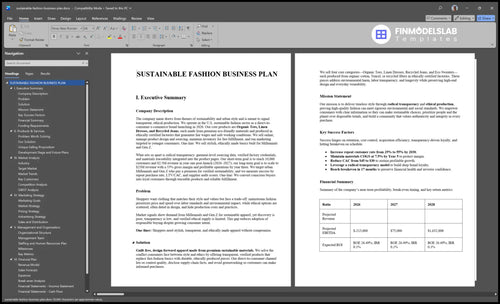
The company name draws from themes of sustainability and urban style and is meant to signal transparent, ethical production. We operate in the U.S. sustainable fashion sector as a direct-to-consumer e-commerce brand launching in 2026. Our core products are Organic Tees, Linen Dresses, and Recycled Jeans, each made from premium eco-friendly materials and produced in ethically certified factories that guarantee fair wages and safe working conditions. We sell online, manage product design and sourcing, maintain inventory for fast fulfillment, and run marketing targeted to younger consumers. One-line: We sell stylish, ethically made basics built for Millennials and Gen Z.
What sets us apart is radical transparency: garment-level sourcing data, verified factory credentials, and materials traceability integrated into the product pages. Our short-term goal is to reach 10,000 customers and $2.5M revenue in year one post-launch (2026–2027); our long-term goal is to scale to $25M revenue with a 55% gross margin and profitable operations by year three. We target urban Millennials and Gen Z who pay a premium for verified sustainability, and we measure success by repeat purchase rate, LTV/CAC, and supplier audit scores. One-line: We convert conscious buyers into loyal customers through traceable products and reliable fulfillment.
Problem
Shoppers want clothing that matches their style and values but face a trade-off: mainstream fashion prioritizes price and speed over labor standards and environmental impact, while ethical options are scattered, often dated in design, and hide production costs and practices.
Market signals show demand from Millennials and Gen Z for sustainable apparel, yet discovery is poor, transparency is low, and verified ethical supply is limited. This gap reduces adoption of responsible buying despite growing consumer intent.
One-liner: Shoppers need stylish, transparent, and ethically made apparel without compromise.
Solution
Guilt-free, design-forward apparel made from premium sustainable materials. We solve the conflict consumers face between style and ethics by offering transparent, verified products that replace fast-fashion basics with durable, ethically produced pieces. Our direct-to-consumer channel lets us control quality, disclose supply-chain facts, and avoid greenwashing so customers can make informed purchases.
We sell four core categories—Organic Tees, Linen Dresses, Recycled Jeans, and Eco Sweaters—each produced from organic cotton, Tencel, or recycled fibers in ethically certified factories. These pieces address environmental harm, labor transparency, and longevity while preserving high-end design and everyday wearability.
Mission Statement
Our mission is to deliver timeless style through radical transparency and ethical production, proving high-quality fashion can meet rigorous environmental and social standards. We empower consumers with clear information so they can make sustainable choices, prioritize people and the planet over disposable trends, and build a community that values authenticity and integrity in every purchase.
Key Success Factors
Success hinges on retention, cost control, acquisition efficiency, transparency-driven loyalty, and hitting breakeven on schedule.
-
Increase repeat customer rate from 25% to 55% by 2030.
-
Maintain materials COGS at 7.5% by Year 5 to protect margin.
-
Reduce CAC from $45 to $30 to sustain profitable growth.
-
Leverage a radical transparency model to build deep brand loyalty.
-
Reach breakeven in 17 months to preserve financial health and investor confidence.
Financial Summary
Summary of the company’s near-term profitability, break-even timing, and key return metrics.
Ratio |
2026 |
2027 |
2028 |
Projected Revenue |
|
|
|
Projected EBITDA |
$-213,000 |
$75,000 |
$1,632,000 |
Expected ROI |
ROE 26.49%; IRR 0.1% |
ROE 26.49%; IRR 0.1% |
ROE 26.49%; IRR 0.1% |
Financial requirements: Plan requires maintaining a minimum cash balance of $626,000 (minimum cash month: Jun-27), supports up to a $600,000 annual marketing budget at scale, targets payback in 29 months with break-even in May-27, and expects positive EBITDA from Year 2 onward.
Outlook: disciplined fixed costs and focus on high-value categories drive a path to strong, scalable EBITDA growth.
Funding Requirements
The company requires $1,069,000 to fund product development, inventory, capex, Year 1 operations and marketing, reach the minimum cash trough, and execute a 17-month path to breakeven (May 2027) with a 29-month payback.
Categories |
Amount, USD |
Product Development (website, CRM, design tools, photography) |
$38,000 |
Initial Inventory |
$25,000 |
Capex (office, warehouse setup, furniture, other) |
$17,000 |
Marketing (Year 1) |
$50,000 |
Staffing — Founder salary (Year 1) |
$100,000 |
Year 1 operating deficit (EBITDA Year 1) |
$213,000 |
Working capital (Minimum cash trough, Jun-27) |
$626,000 |
Total funding required |
$1,069,000 |
Financial summary: Year 1 EBITDA is -$213,000, Year 2 EBITDA is $75,000, Year 5 EBITDA is $17,203,000; plan assumes a $600,000 annual marketing budget, a 29-month payback, 26.49% ROE, and 0.1% IRR.