UPCYCLED FASHION BRAND BUSINESS PLAN
I. Executive Summary
Company Description
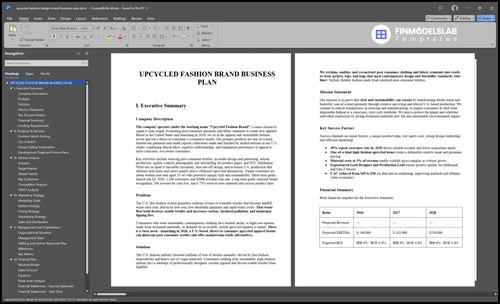
The company operates under the working name "Upcycled Fashion Brand", a name chosen to signal a clear origin: reclaiming post-consumer garments and fabric remnants to create new apparel. Based in the United States and launching in 2026, we sit in the apparel and sustainable fashion sector and run a direct-to-consumer e-commerce model. Our primary products are one-of-a-kind, limited-run garments and small capsule collections made and finished by skilled artisans in our U.S. studio, combining ethical labor, superior craftsmanship, and transparent provenance to appeal to style-conscious, eco-aware consumers.
Key activities include sourcing post-consumer textiles, in-studio design and patterning, artisan production, quality control, photography and storytelling for product pages, and DTC fulfillment. What sets us apart is traceable circularity, true one-off design, and in-house U.S. production that shortens lead times and raises quality above offshored upcycled alternatives. Target customers are urban women and men aged 25–45 who prioritize unique style and sustainability. Short-term goals: launch site Q2 2026, 1,200 customers and $300k revenue year one. Long-term goals: national brand recognition, 10x revenue by year five, and a 75% reuse-to-new material ratio across product lines.
Problem
The U.S. fast-fashion system generates millions of tons of wearable textiles that become landfill waste each year, driven by low-cost, low-durability garments and rapid trend cycles. That waste flow both destroys usable textiles and increases carbon, chemical pollution, and municipal tipping fees.
Consumers who want sustainable, contemporary clothing face limited, niche, or high-cost options made from reclaimed materials, so demand for accessible, stylish upcycled apparel is unmet. There is a clear need—launching in 2026, a U.S.-based, direct-to-consumer upcycled apparel brand can intercept post-consumer textiles and offer mainstream-ready alternatives.
Solution
The U.S. fashion industry discards millions of tons of textiles annually, driven by fast-fashion disposability and heavy use of virgin materials. Consumers seeking truly sustainable, high-fashion options face a shortage of professionally designed, circular apparel that diverts usable textiles from landfills.
We reclaim, sanitize, and reconstruct post-consumer clothing and fabric remnants into ready-to-wear jackets, tops, and bags that meet contemporary design and durability standards. One-liner: Stylish, durable fashion made from sanitized post-consumer textiles.
Mission Statement
Our mission is to prove that style and sustainability can coexist by transforming textile waste into beautiful, one-of-a-kind garments through creative upcycling and ethical U.S.-based production. We commit to radical transparency in sourcing and manufacturing, to inspire consumers to shift from disposable fashion to a conscious, story-rich wardrobe. We aim to protect the planet and celebrate individual expression by giving reclaimed materials new life and measurable environmental impact.
Key Success Factors
Success depends on repeat buyers, a unique product edge, low input costs, strong design leadership, and efficient marketing.
-
45% repeat customer rate by 2030 drives reliable revenue and lower acquisition needs.
-
One-of-a-kind high-fashion upcycled items create a defensible creative moat and premium pricing.
-
Material costs at 3% of revenue enable scalable gross margins as volume grows.
-
Experienced Lead Designer and Production Lead ensure product quality for Millennial and Gen Z buyers.
-
CAC reduced from $45 to $30 via data-driven marketing, improving payback and lifetime value economics.
Financial Summary
Brief financial snapshot for the Executive Summary.
Ratio |
2026 |
2027 |
2028 |
Projected Revenue |
— |
— |
— |
Projected EBITDA |
$-148,000 |
$-103,000 |
$256,000 |
Expected ROI |
IRR 6% / ROE 4.4% |
IRR 6% / ROE 4.4% |
IRR 6% / ROE 4.4% |
Financial requirements: minimum cash reserve $605,000 (minimum cash month Jan‑2028); breakeven expected Feb‑2028 (26 months); payback ~39 months. Anticipated return: IRR 6% and ROE 4.4% with EBITDA rising to $3,088,000 by 2030.
Overall outlook: lean cost base and staged growth drive positive EBITDA and modest investor returns by 2030.
Funding Requirements
We require $605,000 to fund capex, Year‑1 marketing, staffing, studio operations, and a 26‑month working‑capital buffer to reach breakeven in February 2028.
Categories |
Amount, USD |
Product Development |
$10,000 |
Marketing (Year 1) |
$15,000 |
Capex (equipment, setup) |
$39,500 |
Staffing (salaries during 26‑month ramp) |
$245,000 |
Operations (studio rent, utilities, fixed costs for 26 months) |
$99,320 |
Other operating reserves |
$3,180 |
Working capital |
$196,000 |
Total funding required |
$605,000 |