

Opening Calendar
Set the opening date, operating days, operating weeks, and closure calendar.


The Upscale Restaurant Financial Model is an editable five-year workbook that forecasts covers, average checks, revenue, costs, and linked financial statements.
Use the workbook to translate an upscale restaurant operating plan into a structured forecast for sales, expenses, cash flow, and financial performance.
Enter the opening calendar, weekday covers, seasonality, average checks, revenue mix, cost assumptions, staffing, and investment inputs; the model updates its calculations and reports.
Revenue starts with weekday covers, converts them through the opening calendar and seasonality, then applies check size and category mix to monthly sales.
Set the opening date, operating days, operating weeks, and closure calendar.
Forecast average covers by weekday and convert the pattern into period volumes.
Apply monthly seasonality to the resulting restaurant cover forecast.
Apply midweek and weekend checks, then allocate sales across revenue categories.
Sum monthly category sales and any separately modeled ancillary sales.
The Revenue Assumptions view organizes opening timing, weekday covers, seasonality, average checks, and category mix used by the restaurant revenue calculation.
 REVENUE ASSUMPTIONS
The COGS & OPEX view separates direct costs, variable expenses, and fixed operating expenses so the forecast can connect sales with restaurant spending.
 COGS & OPEX
The Scenario Analysis view compares Low, Base, and High cases across revenue, gross margin, contribution margin, and EBITDA over the five-year forecast.
 SCENARIO ANALYSIS
The Dashboard combines model setup, scenario controls, revenue mix, profitability, cash flow, and investment payback outputs in one management reporting view.
 DASHBOARD
The ready-made structure fits restaurants using shared covers and average checks; structurally different revenue systems or reporting needs may call for custom modeling.
The template is a planning starting point, not a guarantee of performance.
Financial Models Lab can build or adapt a model when your requirements need different revenue logic, operating schedules, or financial reporting.
ORDER A CUSTOM FINANCIAL MODELAfter checkout, you receive the editable Upscale Restaurant Financial Model for Excel or Google Sheets as an instant download.
Open and edit the financial model in Excel or Google Sheets.
Plan the restaurant across a five-year projection horizon with linked schedules.
Compare Low, Base, and High cases through the model scenario view.
Review linked statements and management reports generated from the forecast assumptions.
The essential answers are visible in full, with no accordion clicks required.
It forecasts weekday covers, converts them through the opening calendar and seasonality, applies midweek or weekend average checks, allocates sales by category, and sums monthly revenue.
You can change the opening date, weekday covers, operating calendar, monthly seasonality, midweek and weekend checks, revenue mix, and separately modeled ancillary sales.
The Scenario Analysis view lets you compare Low, Base, and High cases across revenue, gross margin, contribution margin, and EBITDA over the forecast.
The workbook includes Income Statement, Cash Flow, Balance Sheet, Dashboard, Summary, Break-Even, Valuation, Ratios, ROIC, Charts, and KPI views shown in the product preview.
Yes. Financial Models Lab can build or adapt a model when you need different revenue logic, operating schedules, or reporting.
It is a planning forecast based on the assumptions entered into the workbook, not a guarantee of business performance.
You get a downloadable financial model for a premium restaurant business, complete with pre-built financial statements, a dynamic dashboard, and fully editable assumptions.
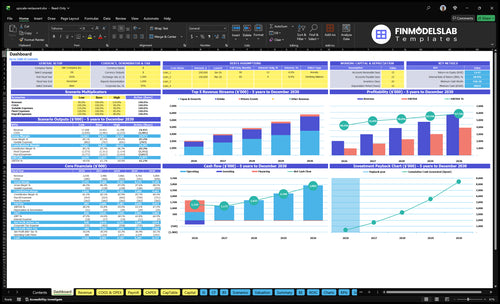
Core inputs and core outputs
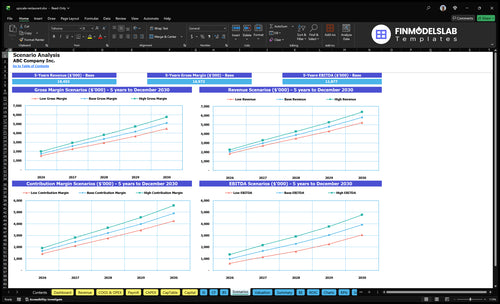
Three scenario analysis
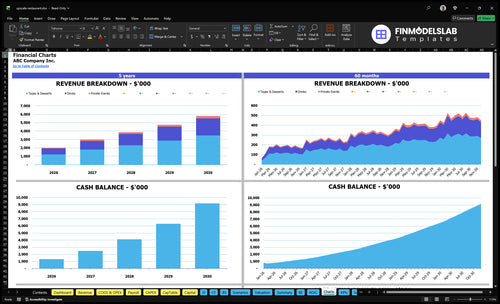
Presentation ready
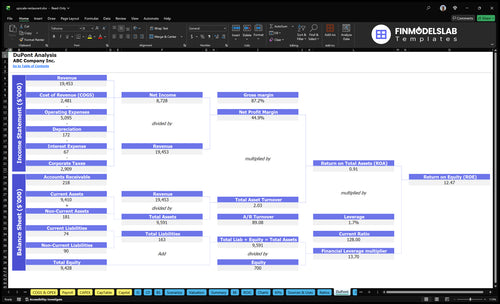
DuPont analysis
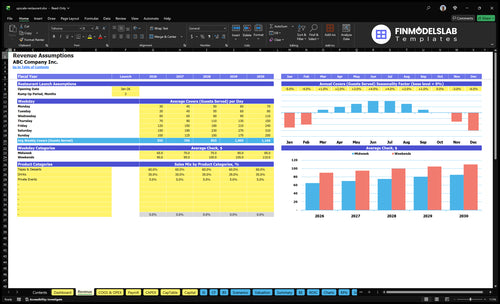
Researched revenue assumptions
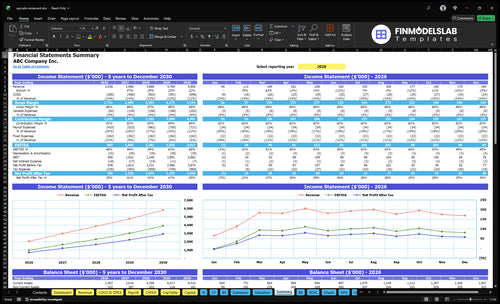
Lender-friendly financial outputs
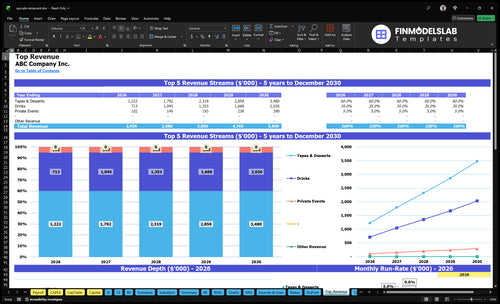
Revenue stream detailed view
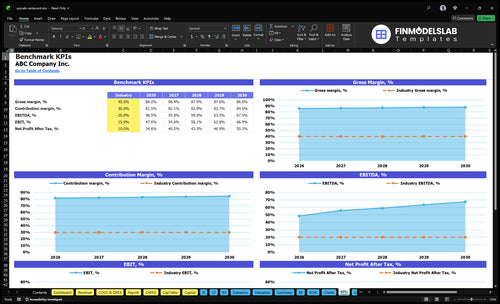
Performance metrics benchmark

I could finally see where the restaurant was making money and where it wasn’t, without digging through a messy sheet. It cut our break-even review from hours to one short meeting.

All the pricing, labor, and growth inputs were in one place, so planning stopped feeling scattered. I had cleaner assumptions ready for our lender call in less than a day.
I was worried one bad formula could throw off the whole model, but this template kept everything structured and easy to follow. That saved me a full rebuild and a lot of second-guessing.