

Revenue and Calc
Edit consultations, conversion, basket size, category mix, prices, seasonality, and launch timing. Monthly Calc projections translate demand into sales.


The Wedding Shop Financial Model is an Excel financial planning template for a U.S. bridal and occasionwear retailer. It converts shopping consultations, purchase conversion, items per customer, merchandise mix, and selling prices into monthly revenue forecasts.
The example is one off-the-rack showroom with immediate merchandise handover and full payment at purchase. It carries six merchandise categories; customer-paid alterations are handled by an independent tailor. Rentals, custom production, and made-to-order deposits are outside this operating case.
The workbook connects store assumptions with monthly calculations, statements, funding, and management reports.
Edit consultations, conversion, basket size, category mix, prices, seasonality, and launch timing. Monthly Calc projections translate demand into sales.
Budget merchandise, freight, card fees, packaging, overhead, and salaries with distinct cost schedules and role-specific FTE assumptions.
Schedule showroom purchases, record owner contributions, and optionally model debt facilities without presuming borrowing in this case.
Monthly statements report earnings, cash movements, inventory, receivables, payables, and balances. Case figures supplied here stop at EBITDA.
Dashboard, Scenarios, Returns, Valuation, and Benchmarks offer profitability, break-even, liquidity, and return analysis without establishing a guaranteed outcome.
Revenue is driven by completed shopping consultations, conversion into purchases, items per transaction, and a six-category allocation of sold units.
The case assumes 130 completed consultations monthly in 2026, 40% purchase conversion, and 1.3 items per buyer. By 2030, consultations reach 220 monthly and conversion rises to 44%, with basket size unchanged.
Sold units are allocated once: bridal gowns 30%, bridesmaid dresses 25%, mother occasion dresses 15%, flower girl dresses 10%, veils and headpieces 10%, and shoes and jewelry 10%. Each category has its own estimated price.
The Revenue Forecast combines consultation demand, conversion, basket size, product mix, selling prices, and seasonality. It calculates projected category units and sales for reviewing the effect of input changes.
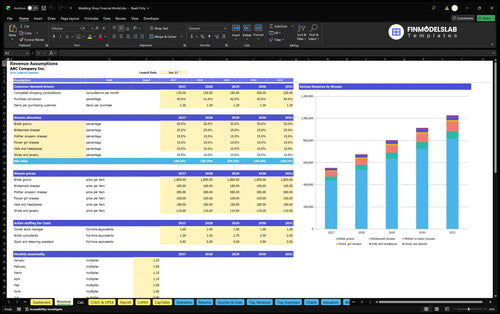
130 consultations/month × 40% conversion × 1.3 items/purchase × $681 weighted item price × 12.0 annual seasonal factor = $552,427 projected revenue.
Estimated prices are $1,800 per bridal gown, $180 per bridesmaid dress, $380 per mother dress, $100 per flower girl dress, $180 for veils, and $110 for shoes and jewelry. Weighted price is $681.
Seasonality repeats annually: March has a 1.15 multiplier, while November and December each use 0.85. The demand model does not impose a capacity ceiling.
The model calculates direct merchandise expense, variable selling costs, fixed store overhead, and separately budgeted payroll before determining operating EBITDA.
The COGS and Operating Expenses report separates merchandise costs, freight, processing, packaging, and recurring overhead. Variable percentage assumptions and fixed monthly inputs show which expenses move with store revenue.
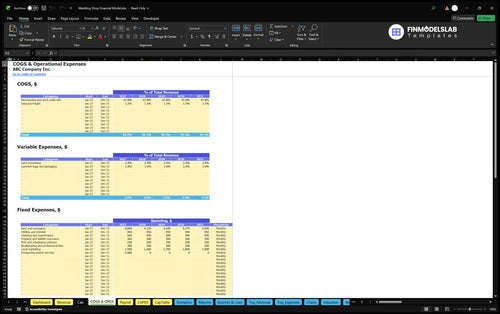
COGS uses estimated merchandise and stock write-offs at 47.8% of sales plus 1.5% freight. Variable assumptions include roughly 2.36% card processing and 1% packaging; fixed expenses cover rent, utilities, cleaning, insurance, software, marketing, and professional services.
The 2026 forecast has $272,347 COGS, $18,535 variable costs, and $96,600 fixed costs. Fixed occupancy spending includes monthly rent of $4,000 in 2026, increasing to $4,500 in 2030.
The Payroll Forecast links role-level FTE, hiring dates, and salaries to personnel expense. It covers the owner manager, bridal consultants, and stock assistant without duplicating merchandise COGS.
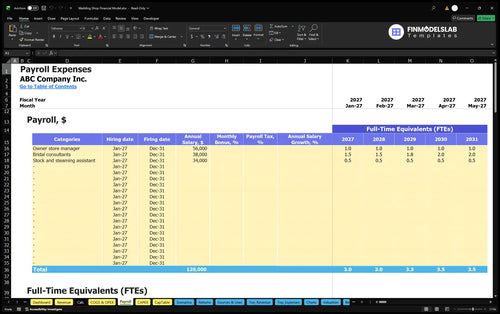
1 owner manager × $56,000 + 1.5 bridal consultant FTE × $38,000 + 0.5 stock assistant FTE × $34,000 = $130,000 annual payroll.
Consultant staffing moves from 1.5 FTE in 2026 to 1.75 in 2028 and 2.0 in 2030. Total annual payroll reaches $149,000 in 2030, counted once.
Startup investment and working-capital needs are planned separately from the shop’s annual operating expenses and EBITDA.
Startup assets total $56,000: $36,000 fitting rooms, $15,000 furniture and racks, $3,000 POS and computers, and $2,000 steamers and garment equipment. Other opening cash items are separate.
Separate opening items include launch cash and a refundable lease deposit. Working-capital settings are zero receivable days, zero payable days, and 116 inventory days, reflecting full-payment retail sales and stocked merchandise.
The Capital Expenditure Plan schedules store improvements, furniture, POS, and equipment purchases with applicable depreciation. These asset investments are separate from operating costs and EBITDA.

Estimated owner funding is $286,935 for opening assets, other opening cash, physical working capital, and a three-month reserve. It is equity capital, not sales, EBITDA, or a bank loan.
The Sources and Uses of Funds report compares funding sources with cash allocated to operations, investments, and financing. This illustration specifies owner funding but no borrowing amount.

The selected case projects growing merchandise demand and higher operating EBITDA from 2026 through 2030, using estimated—not observed—retail assumptions.
| Year | Revenue | Operating Expenses | EBITDA |
|---|---|---|---|
| 2026 | $552,427 | $517,482 | $34,945 |
| 2027 | $675,130 | $575,731 | $99,399 |
| 2028 | $803,144 | $655,278 | $147,867 |
| 2029 | $913,630 | $725,714 | $187,916 |
| 2030 | $1,028,364 | $788,888 | $239,477 |
Estimated illustrative case outputs, rounded to whole dollars. Display rounding may cause minor differences between line items.
Revenue increases from $552,427 in 2026 to $1,028,364 in 2030 as assumed consultations and conversion grow. EBITDA increases from $34,945 to $239,477 after forecast operating costs.
EBITDA margin rises from approximately 6.3% to 23.3%. These are projected outcomes of estimated assumptions, not actual results, industry averages, or guaranteed profits.
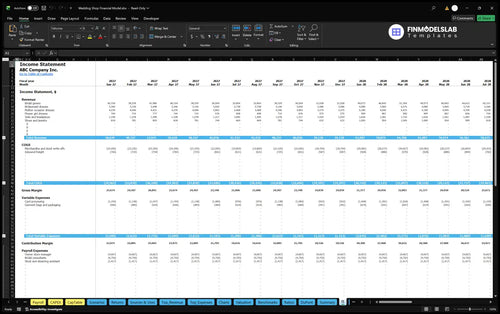
The Income Statement moves from sales and gross margin through operating costs and EBITDA to depreciation, interest, tax, and net profit. Only EBITDA amounts are documented for this illustrative case.
Inventory purchases and showroom improvements may consume cash before sales arrive, even with immediate full payment from customers.
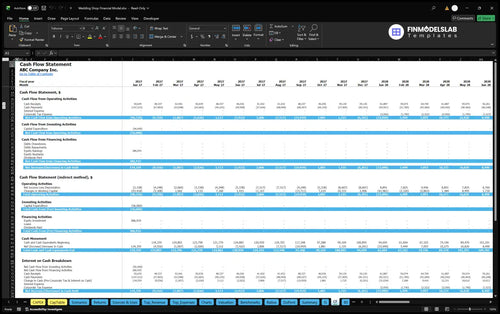
The Cash Flow Forecast tracks operating cash receipts and payments, asset spending, equity, and any modeled financing. It highlights liquidity requirements that EBITDA cannot establish on its own.
Use analysis reports to test retail assumptions and evaluate operating, cash recovery, and investment-return questions.
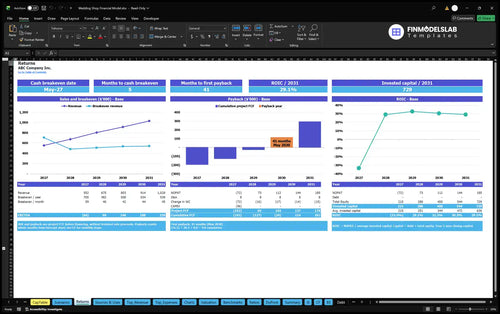
Sales break-even estimates operating cost coverage; cash break-even considers cash movement. Investment payback tests when cumulative cash flow recovers capital, while annual ROIC measures a separate return ratio. None follows automatically from EBITDA.
The Returns analysis distinguishes sales break-even, cash break-even, investment payback, and annual ROIC. These reports help evaluate operating cost coverage and potential capital recovery using cash-flow assumptions.
Dashboard Scenario Controls provide Low, Base, and High multipliers for revenue, COGS, variable expenses, fixed expenses, and payroll. Compare resulting EBITDA paths without assuming an undocumented downside amount.
The template fits operators and advisors evaluating a single-location, inventory-led bridal and occasionwear showroom.
Compare consultation targets, conversion, prices, buying costs, rent, staffing, and initial capital to test an off-the-rack store plan.
Rentals, custom orders, deposits, in-house alterations, or multiple stores require different business mechanics and further modeling.
These answers clarify calculation, editable inputs, forecast scope, and business assumptions.
It multiplies completed shopping consultations by purchase conversion and items per customer, allocates sold items across six categories, then applies their prices and monthly seasonality.
Yes. The revenue plan contains category-specific prices and sales allocations, alongside consultation, conversion, basket, and seasonal demand assumptions.
No. It assumes immediate off-the-rack merchandise sales, with any alterations arranged and paid for directly by customers through an independent tailor.
The Payroll schedule uses staffing FTE and salaries by role. These expenses are separate from COGS and fixed costs, avoiding double counting.
It presents illustrative annual revenue, total operating expenses, and EBITDA for 2026–2030, not actual historical results, cash flow, or net profit.
No. It is the estimated initial owner funding needed for assets, other opening cash, physical working capital, and a three-month reserve.
Yes. Cash Flow, Balance Sheet, Sources & Uses, and Returns reports support those analyses, but this case provides no tested payback date or cash-sufficiency conclusion.
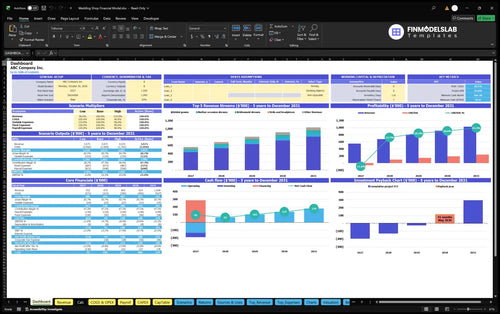
KPIs, forecasts, and cash flow at a glance.
Key assumptions and calculations driving revenue forecasts.
Funding sources, spending, and closing cash.
Cash break-even, payback, and ROIC.
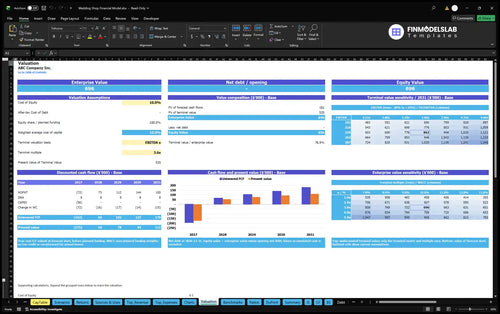
DCF valuation and sensitivity analysis.

Largest costs and spending trends.
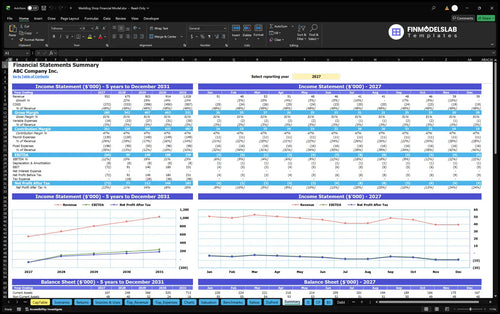
Annual and monthly financial performance.
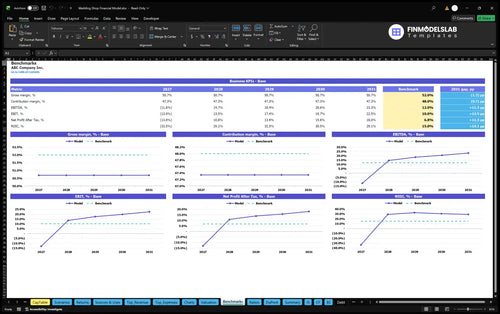
Compare margins and returns to benchmarks.

I stopped juggling low, base, and high cases in separate sheets. The template let me compare all three in one place, which saved me a few hours every time I changed assumptions.

My statements and charts were scattered before, and that made updates messy. Now everything sits in one workbook, so I can send a clean version to my team in minutes.
I’m not strong with advanced Excel, so I usually avoid building models from scratch. This template made the inputs easy to follow, and I booked my planning meeting the same day.