WINE IMPORTING BUSINESS PLAN
I. Executive Summary
Company Description
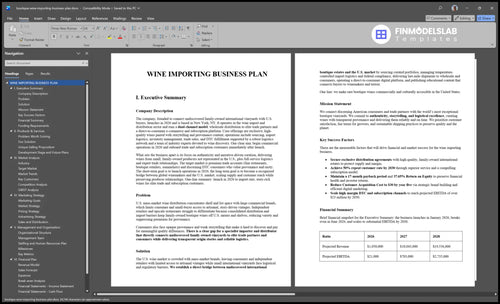
The company, founded to connect undiscovered family-owned international vineyards with U.S. buyers, launches in 2026 and is based in New York, NY. It operates in the wine import and distribution sector and runs a dual-channel model: wholesale distribution to elite trade partners and a direct-to-consumer e-commerce and subscription platform. Core offerings are exclusive, high-quality wines paired with storytelling and provenance content; operations include sourcing, import logistics, inventory management, trade sales, and DTC fulfillment supported by a robust logistics network and a team of industry experts devoted to wine discovery. One clear aim: begin commercial operations in 2026 and onboard trade and subscription customers immediately after launch.
What sets the business apart is its focus on authenticity and narrative-driven curation, delivering wines from small, family-owned producers not represented in the U.S., plus full-service logistics and expert trade relationships. The target market is premium trade accounts (fine restaurants, boutique retailers, sommeliers) and discerning DTC consumers who value provenance and rarity. The short-term goal is to launch operations in 2026; the long-term goal is to become a recognized bridge between global winemakers and the U.S. market, scaling supply and customer reach while preserving producer relationships. One-line summary: launch in 2026 to import rare, story-rich wines for elite trade and subscription customers.
Problem
U.S. mass-market wine distribution concentrates shelf and list space with large commercial brands, which limits consumer and small-buyer access to artisanal, story-driven vintages. Independent retailers and upscale restaurants struggle to differentiate because consolidated distribution and import barriers keep family-owned boutique wines off U.S. menus and shelves, reducing variety and suppressing premiums for provenance.
Consumers also face opaque provenance and weak storytelling that make it hard to discover and pay for meaningful quality differences. There is a clear gap for a specialist importer and distributor that directly connects undiscovered family-owned vineyards to elite trade partners and consumers while delivering transparent origin stories and reliable logistics.
Solution
The U.S. wine market is crowded with mass-market brands, leaving consumers and independent retailers with limited access to artisanal vintages while small international vineyards face logistical and regulatory barriers. We establish a direct bridge between undiscovered international boutique estates and the U.S. market by sourcing curated portfolios, managing temperature-controlled import logistics and federal compliance, delivering last-mile shipments to wholesale and consumers, operating a direct-to-consumer digital platform, and publishing educational content that connects buyers to winemakers and terroir.
One line: we make rare boutique wines commercially and culturally accessible in the United States.
Mission Statement
We connect discerning American consumers and trade partners with the world’s most exceptional boutique vineyards. We commit to authenticity, storytelling, and logistical excellence, curating wines with transparent provenance and delivering them reliably and on time. We prioritize customer satisfaction, fair terms for growers, and sustainable shipping practices to preserve quality and the planet.
Key Success Factors
These are the measurable factors that will drive financial and market success for the wine importing business.
-
Secure exclusive distribution agreements with high-quality, family-owned international estates to protect supply and margin.
-
Achieve 50% repeat customer rate by 2030 through superior service and a compelling subscription model.
-
Maintain a 17-month payback period and 37.65% Return on Equity to preserve financial health and investor returns.
-
Reduce Customer Acquisition Cost to $30 by year five via strategic brand building and efficient digital marketing.
-
Scale high-margin DTC and subscription channels to reach projected EBITDA of over $23 million by 2030.
Financial Summary
Brief financial snapshot for the Executive Summary: the business launches in January 2026, breaks even in June 2026, and scales to substantial EBITDA by 2030.
Ratio |
2026 |
2027 |
2028 |
Projected Revenue |
$1,050,000 |
$10,043,000 |
$19,536,000 |
Projected EBITDA |
$21,000 |
$703,000 |
$2,735,000 |
Expected ROI |
15.0% (IRR) |
15.0% (IRR) |
15.0% (IRR) |
Financial requirements: Minimum cash required is $834,000 (minimum cash month: Feb-26). Anticipated return: 15.0% IRR, 37.65% ROE, 17 months payback; breakeven expected June 2026.
Outlook: modest initial EBITDA with rapid scale—break-even in six months and strong returns on invested equity.
Funding Requirements
The company requires $834,000 to fund launch, cover the first-year payroll, and carry a six-month breakeven buffer through June 2026.
Categories |
Amount, USD |
Capex (warehouse setup, van, storage, IT, branding) |
$130,000 |
Marketing launch (Q1 2026) |
$25,000 |
Initial legal & licensing fees (Q1 2026) |
$10,000 |
Working capital — first 12 months of core management salaries |
$205,000 |
Buffer to breakeven (6 months to Jun-26) |
$464,000 |
Working capital |
$205,000 |
Total funding required |
$834,000 |
Projected year-one EBITDA is $21,000, scaling to $23,157,000 by 2030; break-even is targeted for June 2026 (six months post-launch); the financial plan assumes a 15% IRR and a 37.65% ROE, lowers wine purchase COGS from 12% to 8% of revenue over five years, and supports a marketing budget that grows to $180,000 annually.