CLOTHING LINE BUSINESS PLAN
I. Executive Summary
Company Description
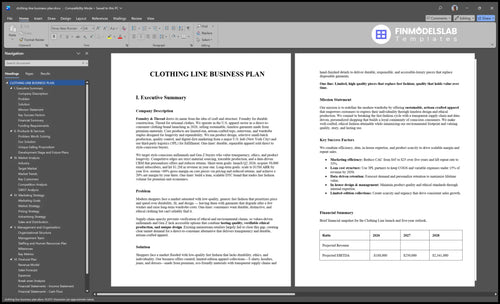
Foundry & Thread draws its name from the idea of craft and structure: Foundry for durable construction, Thread for artisanal clothes. We operate in the U.S. apparel sector as a direct-to-consumer clothing brand launching in 2026, selling sustainable, timeless garments made from premium materials. Core products are limited-run, artisan-crafted tops, outerwear, and wardrobe staples designed for longevity and repairability. We run product design, selective small-batch production, quality control, and digital-first marketing from a major U.S. hub (New York City) and use third-party logistics (3PL) for fulfillment. One-liner: durable, repairable apparel sold direct to style-conscious buyers.
We target style-conscious millennials and Gen Z buyers who value transparency, ethics, and product longevity. Competitive edges are strict material sourcing, traceable production, and a data-driven CRM that personalizes offers and reduces returns. Short-term goals: launch Q2 2026, acquire 50,000 email subscribers, and hit $1.2M in revenue in year one. Long-term goals: scale to $15M ARR by year five, sustain >60% gross margin on core pieces via pricing and reduced returns, and achieve a 20% net margin by year three. One-liner: build a lean, scalable DTC brand that trades fast fashion volume for premium unit economics.
Problem
Modern shoppers face a market saturated with low-quality, generic fast fashion that prioritizes price and speed over durability, fit, and design — leaving them with garments that degrade after a few washes and raise long-term wardrobe costs. One-liner: consumers want durable, distinctive, and ethical clothing but can't reliably find it.
Supply-chain opacity prevents verification of ethical and environmental claims, so values-driven millennials and Gen Z lack accessible options that combine lasting quality, verifiable ethical production, and unique design. Existing mainstream retailers largely fail to close this gap, creating clear unmet demand for a direct-to-consumer alternative that delivers transparency and durable, artisan-crafted apparel.
Solution
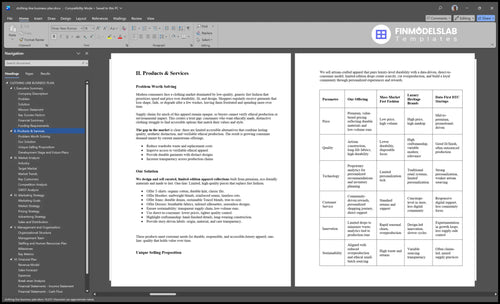
Shoppers face a market flooded with low-quality fast fashion that lacks durability, ethics, and individuality. Our business offers curated, limited-edition apparel collections—T-shirts, hoodies, jeans, and dresses—made from premium, eco-friendly materials with transparent supply chains and hand-finished details to deliver durable, responsible, and accessible-luxury pieces that replace disposable garments.
One-line: Limited, high-quality pieces that replace fast fashion; quality that holds value over time.
Mission Statement
Our mission is to redefine the modern wardrobe by offering sustainable, artisan-crafted apparel that empowers customers to express their individuality through timeless design and ethical production. We commit to breaking the fast-fashion cycle with a transparent supply chain and data-driven, personalized shopping that builds a loyal community of conscious consumers. We make well-crafted, ethical fashion attainable while minimizing our environmental footprint and valuing quality, story, and lasting use.
Key Success Factors
We combine efficiency, data, in-house expertise, and product scarcity to drive scalable margin and repeat sales.
-
Marketing efficiency: Reduce CAC from $45 to $25 over five years and lift repeat rate to 55%.
-
Lean cost structure: Use 3PL partners to keep COGS and variable expenses under 15% of revenue by 2030.
-
Data-driven retention: Forecast demand and personalize retention to maximize lifetime value.
-
In-house design & management: Maintain product quality and ethical standards through internal expertise.
-
Limited-edition collections: Create scarcity and urgency that drive consistent sales growth.
Financial Summary
Brief financial snapshot for the Clothing Line launch and five‑year outlook.
Ratio |
2026 |
2027 |
2028 |
Projected Revenue |
|
|
|
Projected EBITDA |
-$188,000 |
$250,000 |
$2,341,000 |
Expected ROI |
11% |
11% |
11% |
Financial requirements include an initial marketing budget of $150,000 and total launch CAPEX of $68,000; minimum cash required is $692,000, breakeven is projected for Mar‑2027, and full investment payback is expected in 26 months; anticipated returns are IRR 11% and ROE 28.97%.
Overall outlook: launch costs are modest, breakeven occurs within 15 months, and profitability scales strongly by year three.
Funding Requirements
We require $692,000 in startup capital to fund product launch, secure an ethical supply chain, and reach breakeven in March 2027.
We project a 2026 launch, marketing spend of $150,000, breakeven by Mar‑2027, EBITDA from −$188,000 (year 1) to $17,298,000 (year 5), ROE 28.97%, IRR 11%, average units/order rising from 1.20 to 1.60, CapEx $68,000, and full payback within 26 months.
Categories |
Amount, USD |
Product Development (design, samples) |
$0 |
Marketing (2026 budget) |
$150,000 |
Operations (office, utilities, software) |
$0 |
Staffing (2026 salaries: CEO, Head of Design, 0.5 FTE MM) |
$247,500 |
CapEx (initial hardware, website, equipment) |
$68,000 |
Supply chain & initial production runs |
$100,000 |
Working capital |
$126,500 |
Total funding required |
$692,000 |