FOOD DISTRIBUTION BUSINESS PLAN
I. Executive Summary
Company Description
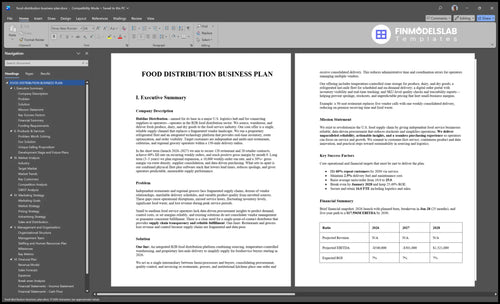
Hubline Distribution—named for its base in a major U.S. logistics hub and for connecting suppliers to operators—operates in the B2B food distribution sector. We source, warehouse, and deliver fresh produce, dairy, and dry goods to the food service industry. Our core offer is a single, reliable supply channel that replaces a fragmented vendor landscape. We run a proprietary refrigerated fleet and an integrated technology platform that provides real-time inventory, route optimization, and order visibility. Target customers are independent and multi-unit restaurants, cafeterias, and regional grocery operators within a 150-mile delivery radius.
In the short term (launch 2026–2027) we aim to secure 120 restaurant and 20 retailer contracts, achieve 60% fill rate on recurring weekly orders, and reach positive gross margin by month 9. Long term (3–5 years) we plan regional expansion, a 10,000 weekly-order run rate, and a 30%+ gross margin via route density, supplier consolidation, and data-driven purchasing. What sets us apart is our combined physical fleet plus software stack that lowers lead times, reduces spoilage, and gives operators predictable, measurable supply performance.
Problem
Independent restaurants and regional grocers face fragmented supply chains, dozens of vendor relationships, unreliable delivery schedules, and variable product quality from unvetted sources. These gaps cause operational disruptions, missed service hours, fluctuating inventory levels, significant food waste, and lost revenue during peak service periods.
Small to medium food service operators lack data-driven procurement insights to predict demand, control costs, or set margins reliably, and existing solutions do not consolidate vendor management or guarantee consistent fulfillment. There is a clear need for a single-point-of-contact distributor that provides supply chain transparency and reliable fulfillment. One-liner: Restaurants and grocers lose revenue and control because supply chains are fragmented and data-poor.
Solution
One line: An integrated B2B food distribution platform combining sourcing, temperature-controlled warehousing, and proprietary last-mile delivery to simplify supply for foodservice buyers starting in 2026.
We act as a single intermediary between farms/processors and buyers, consolidating procurement, quality control, and invoicing so restaurants, grocers, and institutional kitchens place one order and receive consolidated delivery. This reduces administrative time and coordination errors for operators managing multiple vendors.
Our offering includes temperature-controlled zone storage for produce, dairy, and dry goods; a refrigerated last-mile fleet for scheduled and on-demand delivery; a digital order portal with inventory visibility and real-time tracking; and SKU-level quality checks and traceability reports—helping prevent spoilage, stockouts, and unpredictable pricing that hurt small-business margins.
Example: a 50-seat restaurant replaces five vendor calls with one weekly consolidated delivery, reducing on-premise receiving time and food waste.
Mission Statement
We exist to revolutionize the U.S. food supply chain by giving independent food service businesses reliable, data-driven procurement that reduces stockouts and simplifies operations. We deliver unparalleled reliability, actionable insights, and a seamless purchasing experience so operators can focus on service and growth. We commit to customer-first service, continuous product and data innovation, and practical steps toward sustainability in sourcing and logistics.
Key Success Factors
Core operational and financial targets that must be met to deliver the plan.
-
Hit 60% repeat customers by 2030 via service.
-
Maintain 2.5% delivery fuel and maintenance cost.
-
Raise average units/order from 10.0 to 25.0.
-
Break even by January 2028 and keep 25.49% ROE.
-
Secure and retain 16.0 FTE including logistics and sales.
Financial Summary
Brief financial snapshot: 2026 launch with planned burn, breakeven in Jan-28 (25 months), and five-year path to a $17.596M EBITDA by 2030.
Ratio |
2026 |
2027 |
2028 |
Projected Revenue |
N/A |
N/A |
N/A |
Projected EBITDA |
-$540,000 |
-$301,000 |
$1,521,000 |
Expected ROI |
7% |
7% |
7% |
Financial requirements include initial capital to cover a planned negative cash run (minimum cash -$259,000 in Dec-27) and capex of ~$268,000; the investment targets a 7% IRR and a 37-month payback on initial capital.
Outlook: the model reaches breakeven in Jan-2028 and scales to strong EBITDA by 2030.
Funding Requirements
The company requires a $577,000 initial funding package to cover capital expenditures and the minimum cash deficit, delivering runway to breakeven (Jan 2028).
Categories |
Amount, USD |
Initial Delivery Fleet (Vehicles) |
$150,000 |
Warehouse Racking and Equipment |
$40,000 |
IT Infrastructure and Servers |
$25,000 |
Office Setup and Furniture |
$15,000 |
Initial Inventory Purchase |
$50,000 |
Software Licenses (Annual Upfront) |
$10,000 |
Forklift and Pallet Jacks |
$20,000 |
Security System Installation |
$8,000 |
Working capital (minimum cash deficit) |
$259,000 |
Total funding required |
$577,000 |
$318,000 in capex plus $259,000 minimum cash delivers runway to breakeven (Jan 2028).