GIFT SHOP BUSINESS PLAN
I. Executive Summary
Company Description
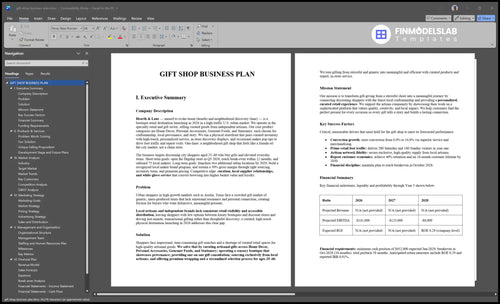
Hearth & Lane — named to evoke home (hearth) and neighborhood discovery (lane) — is a boutique retail destination launching in 2026 in a high-traffic U.S. urban market. We operate in the specialty retail and gift sector, selling curated goods from independent artisans. Our core product categories are Home Decor, Personal Accessories, Gourmet Foods, and Stationery, each chosen for craftsmanship, local provenance, and story. We run a physical storefront that pairs curated inventory with high-touch, personalized service, in-store discovery displays, and occasional maker pop-ups to drive foot traffic and repeat visits. One-liner: a neighborhood gift shop that feels like a friends-of-the-city market, not a chain store.
The business targets discerning city shoppers aged 25–60 who buy gifts and elevated everyday items. Short-term goals: open the flagship store in Q3 2026, reach break-even within 12 months, and onboard 75 local makers. Long-term goals: franchise two additional urban locations by 2029, build a recognized local maker brand program, and sustain a 50% gross margin through tight sourcing, inventory turns, and premium pricing. Competitive edge: curation, local supplier relationships, and white-glove service that convert browsing into higher basket value and loyalty.
Problem
Urban shoppers in high-growth markets such as Austin, Texas face a crowded gift market of generic, mass-produced items that lack emotional resonance and personal connection, creating friction for buyers who want distinctive, meaningful presents.
Local artisans and independent brands lack consistent retail visibility and accessible distribution, leaving shoppers with few options between luxury boutiques and discount stores and driving last-minute, transactional gifting rather than thoughtful discovery; a curated, high-touch physical destination launching in 2026 addresses this clear gap.
Solution
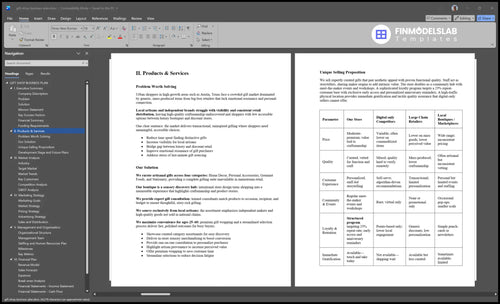
Shoppers face impersonal, time-consuming gift searches and a shortage of curated retail spaces for high-quality artisanal goods. We solve that by curating artisanal gifts across Home Decor, Personal Accessories, Gourmet Foods, and Stationery; operating a sensory boutique that showcases provenance; providing one-on-one gift consultation; sourcing exclusively from local artisans; and offering premium wrapping and a streamlined selection process for ages 25–60.
We turn gifting from stressful and generic into meaningful and efficient with curated products and expert, in-store service.
Mission Statement
Our mission is to transform gift-giving from a stressful chore into a meaningful journey by connecting discerning shoppers with the finest local craftsmanship and providing a personalized, curated retail experience. We support the artisan community by showcasing their work on a sophisticated platform that values quality, creativity, and local impact. We help customers find the perfect present for every occasion so every gift tells a story and builds a lasting connection.
Key Success Factors
Critical, measurable drivers that must hold for the gift shop to meet its forecasted performance.
-
Conversion growth: raise conversion from 8.0% to 16.0% via superior service and merchandising.
-
Prime retail foot traffic: deliver 200 Saturday and 180 Sunday visitors in year one.
-
Artisan network fidelity: secure exclusive, high-quality supply from local artisans.
-
Repeat customer economics: achieve 40% retention and an 18-month customer lifetime by 2030.
-
Financial discipline: maintain plan to reach breakeven in October 2028.
Financial Summary
Key financial milestones, liquidity and profitability through Year 3 shown below.
Ratio |
2026 |
2027 |
2028 |
Projected Revenue |
N/A (not provided) |
N/A (not provided) |
N/A (not provided) |
Projected EBITDA |
-$141,000 |
-$123,000 |
-$8,000 |
Expected ROI |
N/A (not provided) |
N/A (not provided) |
ROE 0.29 (company-level) |
Financial requirements: minimum cash position of $452,000 expected Jan‑2029; breakeven in Oct‑2028 (34 months); total payback 58 months. Anticipated return measures include ROE 0.29 and reported IRR 0.01%.
Outlook: steady path to positive EBITDA with a Year 5 EBITDA of $603,000 and strengthened margins from 12% COGS in Year 1 to 10% by Year 5.
Funding Requirements
Total required funds bridge startup costs to stable positive cash flow.
Categories |
Amount, USD |
Product Development (Website) |
$7,000 |
Marketing (Initial materials) |
$2,000 |
Operations (Leasehold improvements, fixtures, POS, security) |
$73,000 |
Inventory (Initial purchase) |
$30,000 |
Staffing (Store Manager - first year salary) |
$60,000 |
Rent (First 12 months at $3,500/mo) |
$42,000 |
Cumulative operating losses through breakeven (Y1–Y3 EBITDA sum) |
$272,000 |
Working capital |
$452,000 |
Total funding required |
$938,000 |
Financial summary: Year 1 EBITDA -$141,000; Year 5 EBITDA $603,000; breakeven in October 2028 (34 months); payback 58 months; COGS 12% (Y1) improving to 10% (Y5); Return on Equity 0.29; minimum cash held $452,000 in early 2029; units per order targeted to 1.5 by 2030.