SMALL RESTAURANT BUSINESS PLAN
I. Executive Summary
Company Description
The company name is not yet finalized and the naming origin is pending. Launching in 2026, we enter the U.S. urban restaurant sector as a chef-driven, limited-seating dining concept that serves breakfast, brunch, and dinner. We offer a seasonal tasting-style menu focused on high-quality ingredients, personal service, and an elevated, serene atmosphere. Our core product is a curated multi-course meal delivered in an intimate setting, supported by reservations, table-side service, and a short, rotating wine and beverage program. One-liner: intimate, chef-driven meals across three daily service periods.
Operations combine traditional culinary craft with advanced data analytics to optimize seating turns, menu pricing, and inventory. Main activities include menu development, reservation management, service staffing, supplier relationships, and analytics-driven yield management. We target high-density urban professionals and food-savvy renters aged 28–55 seeking quiet, high-touch dining alternatives to chains. Short-term goals: open first location and reach break-even within 12 months. Long-term goals: refine the analytics platform, replicate the format in three additional markets within five years. Competitive edge is the blend of hospitality-first service with data-led operations that lift margins without sacrificing quality. One-liner: scalable, data-informed hospitality for discerning urban diners.
Problem
Urban diners face a market saturated by impersonal chain restaurants where speed and volume override quality, leaving a clear gap for guests who want intimate, thoughtful meals with calm service, high-quality ingredients, and a serene atmosphere.
One-liner: diners want personal connection and sensory pleasure, not conveyor-belt dining.
Solution
Discerning diners in the U.S. face a shortage of high-quality, intimate dining options because the market is dominated by high-volume, speed-focused chains that prioritize throughput over atmosphere and service. Guests seeking meaningful conversation and a calm environment often leave feeling treated like transactions rather than people.
We deliver a curated, limited‑seating dining experience that restores intimacy and attention: a cozy, low-capacity dining room engineered for calm; seasonal, precisely plated menus for breakfast, brunch, and dinner; and staff trained for consistent, personalized service from arrival to departure.
Mission Statement
Our mission is to deliver an exceptional, personal dining experience by combining seasonal, chef-driven cuisine with data-informed operations to ensure consistent quality and service. We create a serene, inviting atmosphere where every guest receives individual care and every meal fosters connection. We commit to financial discipline, sustainability, and culinary excellence to be the city’s premier intimate dining destination.
Key Success Factors
Success depends on maintaining targeted economics, operational excellence, and standout hospitality to drive loyalty and word-of-mouth.
-
$85 average order value (weekends, 2026) sustaining revenue per cover.
-
35% food sales mix optimized for product cost and menu engineering.
-
50% wine sales mix boosting high-margin beverage revenue.
-
Experienced Owner/GM and Head Chef ensuring consistent operations and culinary quality.
-
14-month breakeven by Feb 2027 as the financial milestone for sustainability.
Financial Summary
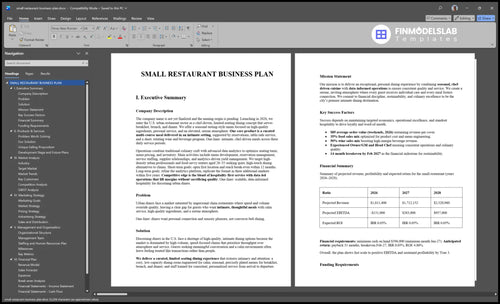
Summary of projected revenue, profitability and expected return for the small restaurant (years 2026–2028).
Ratio |
2026 |
2027 |
2028 |
Projected Revenue |
$1,011,400 |
$1,712,152 |
$2,520,960 |
Projected EBITDA |
-$151,000 |
$383,000 |
$957,000 |
Expected ROI |
IRR 0.05% |
IRR 0.05% |
IRR 0.05% |
Financial requirements: minimum cash on hand $396,000 (minimum month Jan-27). Anticipated return: payback 31 months, breakeven Feb-27, IRR 0.05%, ROE 4.86%.
Overall: the plan shows fast scale to positive EBITDA and sustained profitability by Year 3.
Funding Requirements
We require $801,000 to launch: supporting initial Capex and a $396,000 minimum cash reserve to reach breakeven in February 2027 with a 31‑month payback (Year 1 EBITDA -$151,000 to Year 5 EBITDA $2,142,000; Saturday covers 75→200; midweek check $65→$95; food COGS 5%; wine/liquor COGS 10%; IRR 0.05%).
Categories |
Amount, USD |
Leasehold improvements |
150,000 |
Kitchen equipment |
60,000 |
Initial wine stock |
70,000 |
Other capex (remaining) |
125,000 |
Working capital |
396,000 |
Total funding required |
801,000 |